
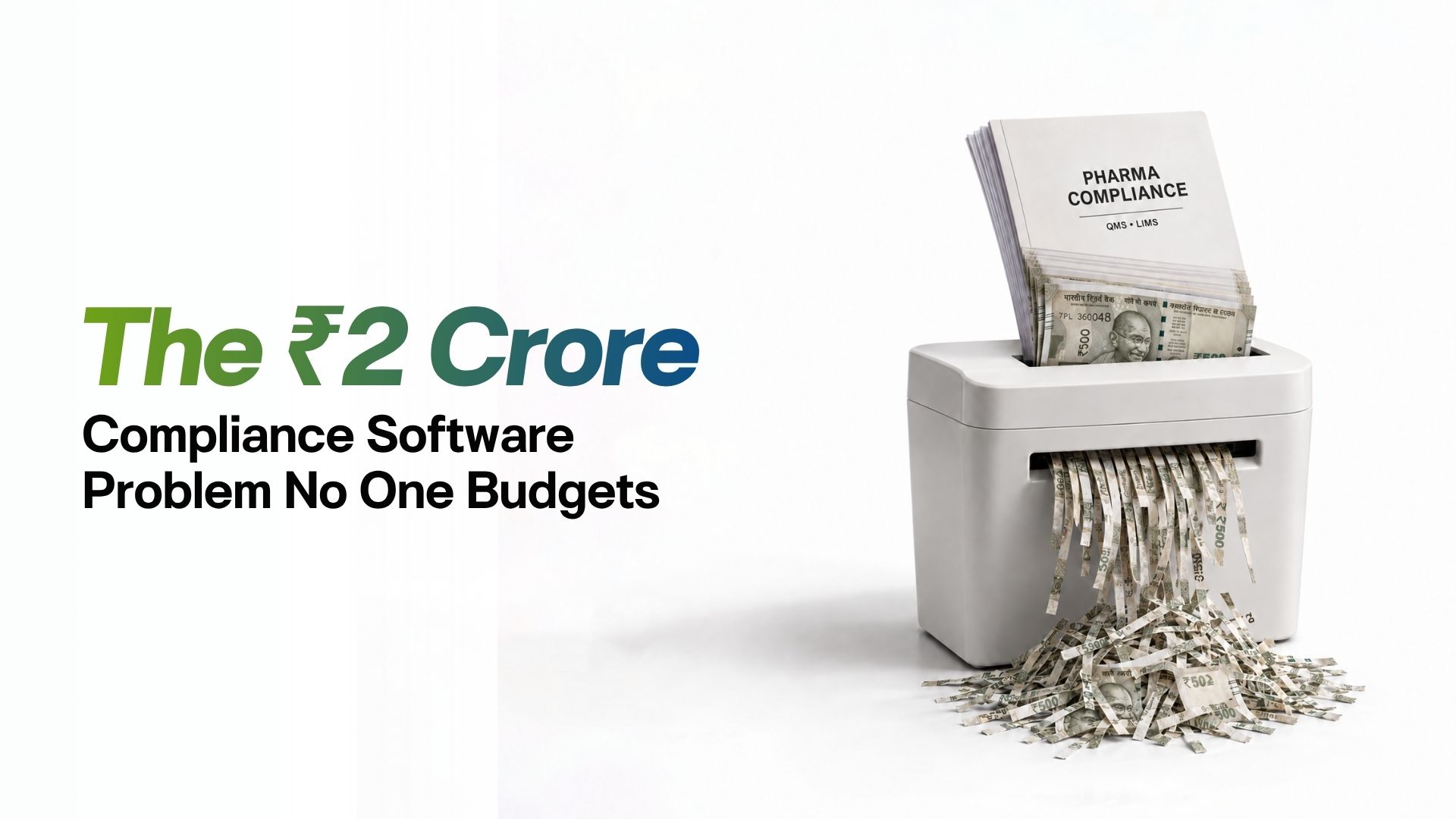
A pharmaceutical company approves ₹70–80 lakh for a new QMS, LIMS or integrated compliance platform.
The system is configured, validated and launched. Management considers the project complete.
Six months later, employees are still using Excel trackers. Some records are maintained both on paper and in the software. QA manually follows up on pending actions. Information is copied between departments, and every workflow change requires vendor support.
The organization has paid for the software. It may now also be paying for the gaps between what the system was designed to do and how work actually happens.
Let us estimate that hidden cost for a hypothetical mid-sized pharmaceutical plant.
Assumptions for the Calculation
Consider a plant with:
- 100 compliance-software users
- 250 working days annually
- Average employee cost of ₹700 per productive hour
- Multiple QMS, laboratory and manufacturing workflows
- An implementation investment of approximately ₹75 lakh
The following calculation is illustrative. Actual costs will depend on plant size, product value, workforce cost and the severity of implementation gaps.
1. Maintaining Parallel Records: ₹78.75 Lakh
Suppose 60 employees spend an additional 45 minutes every day updating paper records, Excel trackers or offline notes because the software does not fully support practical execution.
Calculation:
60 employees × 0.75 hours × 250 days × ₹700
Annual cost: ₹78,75,000
This is not productive quality work. It is the cost of maintaining a second system -. because the system does not fully support the way the process is executed in practice, or because users continue to rely on familiar workarounds. Not the work but the problem is paying twice for the same information to be recorded, reconciled and reviewed.
2. Manual Reconciliation and Rework: ₹16.80 Lakh
Assume 20 employees spend ten hours every month reconciling information between QMS, LIMS, documents, emails and spreadsheets.
Calculation:
20 employees × 10 hours × 12 months × ₹700
Annual cost: ₹16,80,000
This includes locating missing information, correcting duplicate entries and confirming which record represents the current status.
3. Delayed Quality Decisions: ₹72 Lakh
Suppose visibility gaps contribute to 12 release-critical delays annually. Each delay extends the decision by two days, with an estimated carrying, scheduling or opportunity cost of ₹3 lakh per day.
Calculation:
12 delays × 2 days × ₹3,00,000
Annual impact: ₹72,00,000
This estimate excludes the much larger potential impact of missed dispatches, production rescheduling or customer escalation.
4. Audit Preparation Effort: ₹11.20 Lakh
If 25 employees spend eight working days preparing, checking and retrieving evidence for major audits:
Calculation:
25 employees × 8 days × 8 hours × ₹700
Annual cost: ₹11,20,000
A well-implemented system should make records continuously retrievable. When audit preparation still requires a dedicated search exercise, the organization is paying to reconstruct visibility it had already purchased.
5. Post-Go-Live Corrections: ₹25 Lakh
Poor requirement definition frequently leads to change controls and change requests for Workflow redesign followed by:
- Additional validation
- Repeated user training
- Data correction
- Additional reports and integrations
A conservative annual provision for such remediation can easily reach:
Estimated cost: ₹25,00,000
These costs are often spread across departmental budgets, which prevents management from seeing them as system-process gap failure.
6. Productivity Lost During Stabilization: ₹14 Lakh
If 100 users lose an average of 20 productive hours during prolonged stabilization, repeated training and workaround development:
Calculation:
100 users × 20 hours × ₹700
Cost: ₹14,00,000
The Estimated Annual Cost
| Cost area | Estimated impact |
| Parallel documentation | ₹78.75 lakh |
| Reconciliation and rework | ₹16.80 lakh |
| Delayed quality decisions | ₹72.00 lakh |
| Audit preparation | ₹11.20 lakh |
| Post-go-live remediation | ₹25.00 lakh |
| Stabilization productivity loss | ₹14.00 lakh |
| Total estimated annual impact | ₹2.18 crore |
The organization invested approximately ₹75 lakh in software implementation but could lose nearly three times that amount every year through poor adoption, fragmented workflows and manual workarounds.
Over three years, the hidden impact could exceed ₹6.5 crore, even before considering inflation or business growth.
What This Estimate Does Not Include
The calculation deliberately excludes major risk events such as:
- Batch rejection
- Product recall
- FDA 483 observations
- Warning letters or import alerts
- Data-integrity findings
- Lost customer contracts
- Production shutdown
- Reputational damage
These risks are not included in the calculation because they are too plant- and event-specific. Their potential impact, however, can be materially larger than routine productivity losses, e.g. One serious compliance event could exceed the entire three-year estimate.
The Real ROI Question
Software ROI should not be calculated only from the cost of licences and implementation.
It should measure whether the system:
- Eliminates parallel records
- Reduces documentation effort
- Shortens review and closure timelines
- Accelerates evidence retrieval
- Connects related workflows
- Improves user adoption
- Detects delays and risks earlier
- Reduces the cost of quality
Better Design & Implementation Begins Before Configuration
A successful implementation does not start by copying existing forms into the software. It starts by identifying the decisions, evidence and outcomes each process must deliver.
SAMWED’s goal-centric approach configures workflows around specific pharmaceutical objectives.
Traditional implementation
Requirement → Configure form → Configure workflow → Validate → Go live
Samwed approach
Business objective → Process → Decisions → Evidence → Workflow → Configuration → Validation → Continuous improvement
Its connected modules across Documents,Equipment,Laboratory,Manufacturing and StoresTraining And Quality Processes, reduce reconciliation between separate applications and prevent digital silos from multiplying.
Poor Choice of System Is Not a One-Time Loss
The most dangerous part of poor choice is not the original ₹75 lakh investment.
It is the ₹2 crore that may quietly disappear every year after the system goes live.
The cost of compliance software is visible in the proposal. The cost of implementing just any software is hidden across the entire plant.
Measure the hidden cost of the gap between digitalization and actual process adoption.