India’s inspection outcomes are improving even as the comfort of advance preparation is diminishing.
Indian pharma sites appear to be entering a more disciplined compliance phase. While total drug facility inspections in India declined from 284 in 2024 to 212 in 2025, the sharper fall in serious enforcement outcomes suggests improving inspection readiness across the sector.
But the message is not comfort, it is caution. With OAI findings capable of blocking new US approvals and disrupting production, Indian pharma companies now need continuous compliance readiness, rather than inspection-time preparation.
The historical data shows three clear patterns:
- Inspections have rebounded after the pandemic dip.
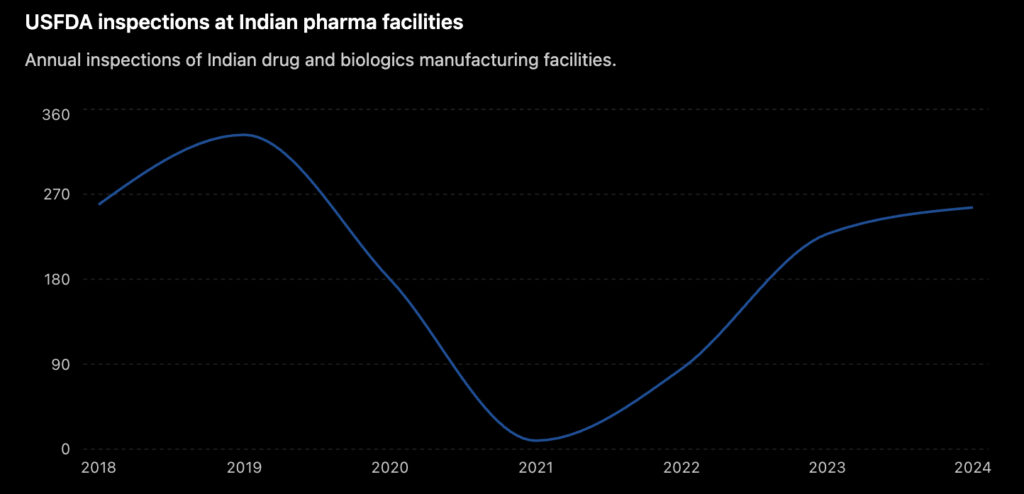
India saw USFDA inspections fall sharply to just 9 in 2021, but they recovered to 256 by 2024, almost back to the 2018 pre-COVID level of 259. - OAI rates have come down meaningfully.
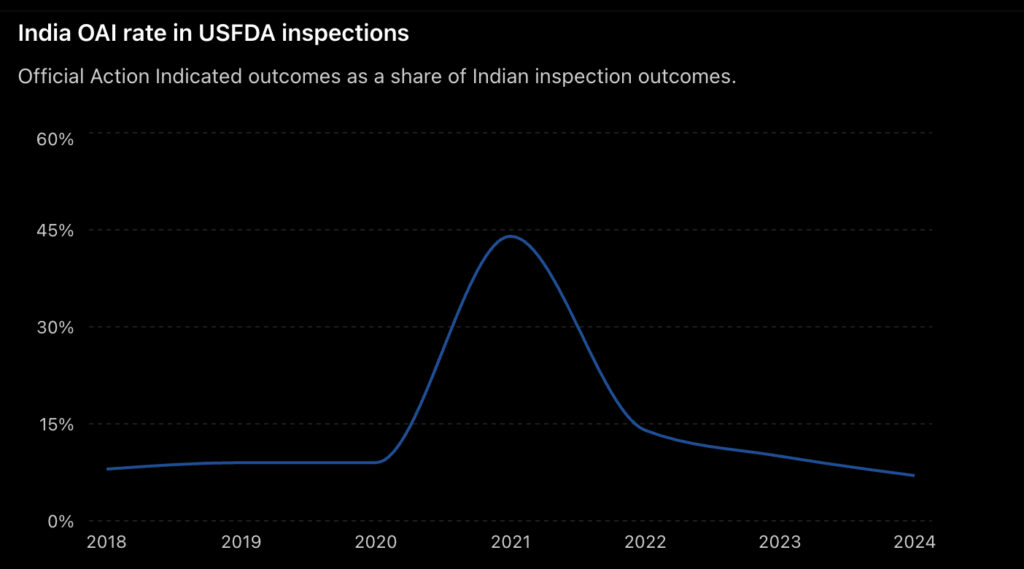
India’s OAI rate fell from 14% in 2022 to 7% in 2024. Longer-term commentary also indicates that OAI rates have moved down from the 15–20% range seen during CY2013–CY2017. - 2025 showed fewer inspections and fewer serious outcomes.
Drug facility inspections declined from 284 in 2024 to 212 in 2025. OAI cases fell from 20 to 11. This is positive, but it should not be read as softer scrutiny. - Inspection volumes and outcomes can also be influenced by risk-based inspection selection, regulatory priorities and inspection allocation. It may also reflect risk-based targeting, stronger systems at larger companies, and changed inspection allocation.
Indian pharma’s USFDA numbers are moving in a direction that looks encouraging.
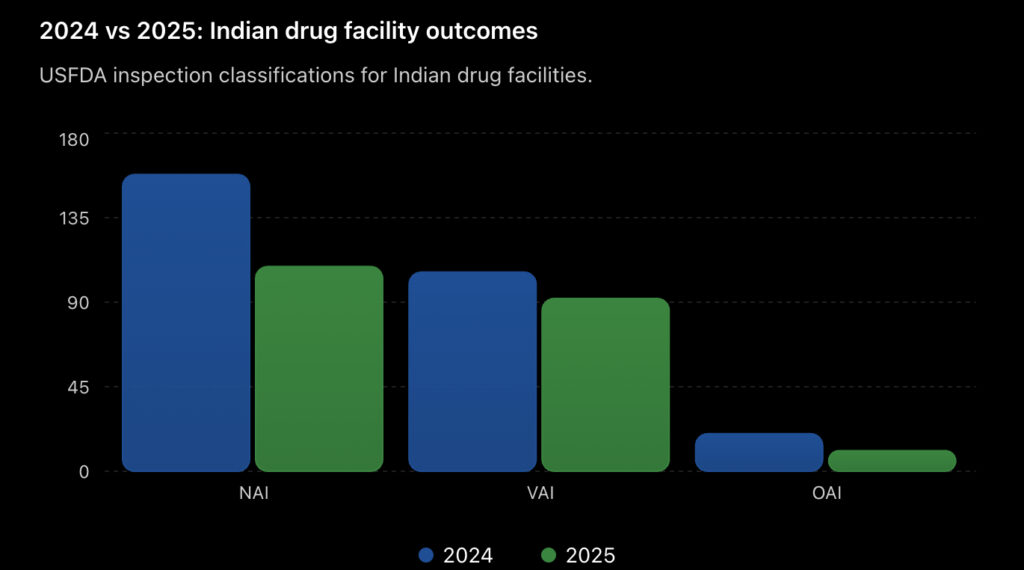
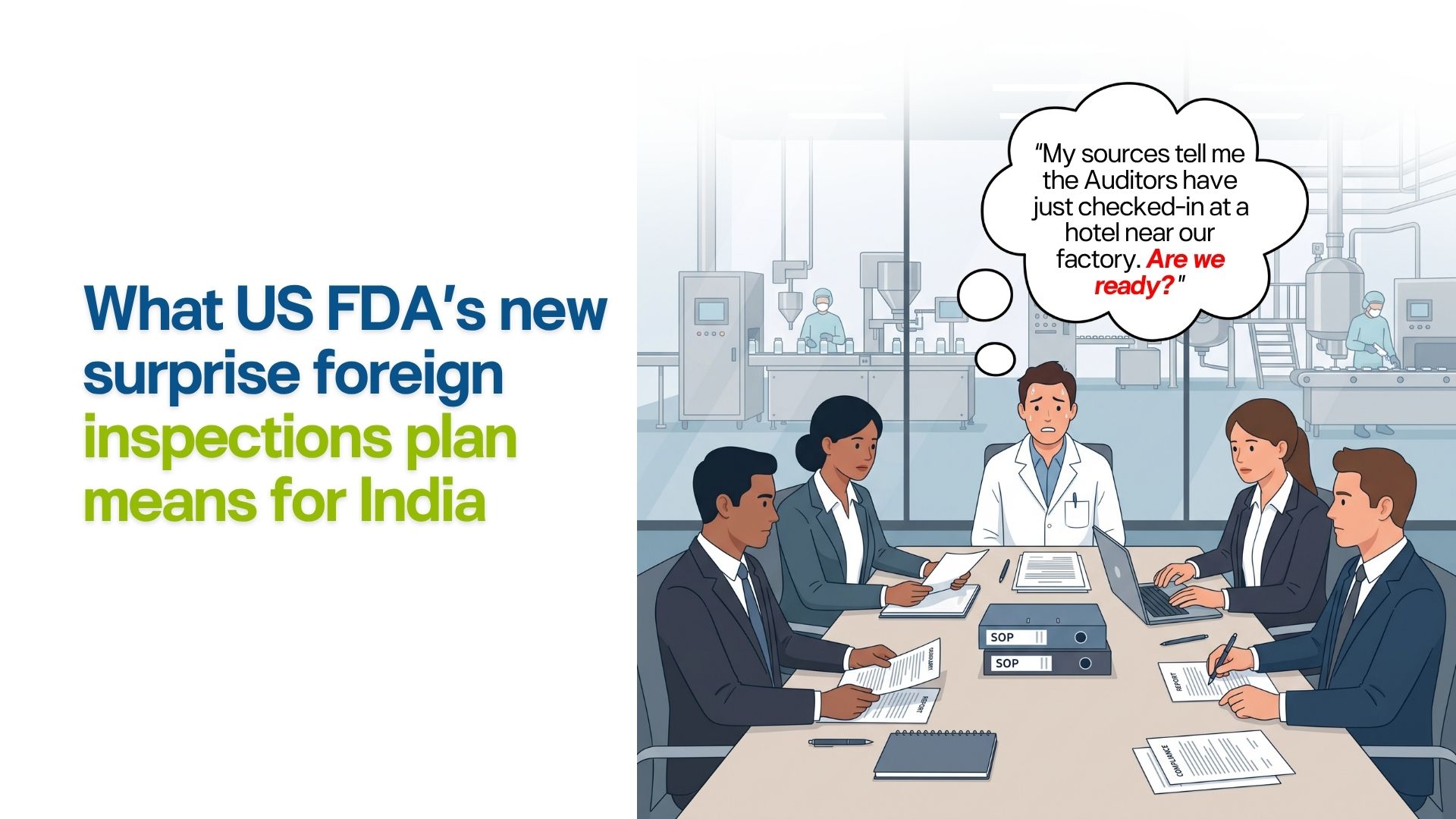
While inspection outcomes are improving, the USFDA’s approach to foreign facility inspections is also evolving, with greater emphasis on unannounced or short-notice inspections.
That changes how one should interpret the data.
Traditionally, an announced inspection allowed organisations time to coordinate teams, review documentation, identify gaps, verify records and prepare responses. Although compliance was always expected, the inspection itself provided a defined period for focused preparation.. Under surprise inspections, that preparation window shrinks significantly .
So the question changes from:
“Can we prepare well for an inspection?”
to:
“Can our normal operating day withstand regulatory scrutiny ?”
An inspector should be able to review a document’s history, trace a deviation through its investigation and CAPA, verify equipment maintenance records, examine laboratory results, check training effectiveness and establish the integrity of batch records without depending on last-minute coordination.
This requires more than well-documented procedures or periodic internal audits. It requires systems in which compliance is built into the way work gets done.
What the numbers are really saying
The first data signal is that inspection volume has normalised after COVID.
India had 259 inspections in 2018 and 333 in 2019. The number collapsed during the pandemic, hitting just 9 in 2021. By 2024, inspections had recovered to 256.
This means the low-inspection pandemic phase is over. Indian pharma is again operating in a high-visibility regulatory environment.
The second signal is more positive.
India’s OAI rate has reduced from 14% in 2022 to 10% in 2023 and 7% in 2024. In 2025, the number of OAI cases in drug facilities fell from 20 to 11.
This suggests that many Indian pharma companies, especially larger export-focused players, have built stronger compliance systems over the last few years.
But the third signal is the most important.
Fewer OAI cases do not automatically mean lower regulatory pressure.
The USFDA is now expanding unannounced foreign inspections. That means the regulator is not only asking whether systems exist. It is testing whether those systems work without advance preparation.
Why surprise inspections matter
Surprise inspections convert compliance from an event into a daily operating standard.
In an announced inspection model, companies can temporarily improve coordination. In a surprise model, inspectors see how the system behaves naturally.
That is why this shift matters more than the inspection count alone.
Even if total inspections fluctuate year to year, the quality of scrutiny has changed. The inspection is no longer only a scheduled checkpoint. It becomes a real-time test of operating discipline and data integrity.
For Indian pharma exporters, this is important because the US remains a major market. Cleaner inspection outcomes support confidence, approvals, and continuity. But surprise inspections raise the benchmark of baseline expectation.
The industry is no longer judged solely on its ability to respond to an audit.
It is being judged on whether compliance is embedded in everyday operations.
The winners will be companies that do not depend on inspection preparation cycles. They will be the companies where documentation, quality events, training, batch & testing records, and audit trails etc. are already tracked contemporaneously.
In the older model, companies prepared for inspection.
In the newer model, companies must operate as if inspection can begin any day.
For Indian pharma, the next compliance advantage will not come from better audit-room preparation.
It will come from systems that make every working day inspection-ready.
Why digital transformation is becoming a compliance imperative
Consider the interconnected nature of pharmaceutical operations.
A deviation may originate from equipment performance, a laboratory result, a manufacturing activity or an environmental condition. Its investigation may require access to equipment history, analytical records, controlled procedures, personnel training records and previous quality events.
When these functions operate in separate systems or depend heavily on manual coordination, establishing the complete picture becomes difficult.
Information may exist, but retrieving it, establishing its relationship with other records and demonstrating its integrity can consume considerable time.
A digitally connected operating environment changes this equation.
Instead of treating documentation, equipment management, laboratory operations, manufacturing records, validation, training and quality management as independent functions, organisations can establish connected workflows with traceable information across the entire operation.
The benefits extend beyond faster document retrieval.
- Real-time compliance visibility: Know the status of documents, approvals, equipment activities, training assignments, investigations and other critical processes.
- Traceability across operations: Establish clear connections between quality events, equipment history, laboratory results, manufacturing records and supporting evidence.
- Controlled execution: Ensure that activities follow approved workflows, with appropriate access controls, authorisations and electronic records.
- Proactive gap identification: Use automated alerts, due-date tracking and workflow monitoring to identify pending or overdue activities before they become larger compliance concerns.
- Reliable audit trails: Maintain a traceable history of changes, decisions, approvals and actions, making it easier to demonstrate the integrity of records.
- Faster regulatory response: Retrieve relevant information and establish the complete context of an event without depending on multiple teams to manually assemble evidence.
The objective is not merely to digitise existing paperwork. It is to transform how compliance information is generated, connected, monitored and demonstrated.
From compliance management to compliance by design with Samwed
Samichinam brings Pharma Operations & compliance functions into one connected system.
DMS, Equipment Management, Laboratory, eBMR, & validation workflows, QMS and training management (LMS) work together seamlessly instead of operating in silos.
The strength of Samwed lies not simply in having these capabilities within one platform, but in how they work together.
This gives Pharma manufacturers a real-time view of documents, quality events, training status, batch records, approvals and comprehensive audit trails. As a result, Teams do not have to rely only on manual follow-ups or last-minute audit preparation.
With automated alerts, role-based access, integrated workflows, and real-time tracking, operational and compliance gaps can be identified earlier and addressed before they become ‘audit observations’. This enables Pharma manufacturers to stay compliance-ready during daily operations, regulatory changes and, of course, for surprise inspections.
The next compliance advantage will be built into everyday operations
The declining OAI rates are an encouraging sign for Indian pharma. They demonstrate that the industry has made progress and that stronger compliance practices are achievable.
But the next phase will demand more.
When inspections can happen with little or no advance notice, organisations cannot afford to depend on periodic preparation cycles, individual knowledge or manual coordination to demonstrate compliance.
They need systems that consistently generate reliable records, connect operational evidence and provide visibility into compliance status.
The opportunity is therefore much bigger than preparing for the next USFDA inspection.
It is about building a more efficient, transparent, controlled and future-ready pharmaceutical organisation.
Samichinam helps pharmaceutical manufacturers move towards this goal with Samwed, transforming disconnected processes into a connected digital ecosystem where quality & compliance is built into everyday operations by design.
Because the true measure of inspection readiness is not how well an organisation prepares when an inspection is announced, but how confidently it can demonstrate compliance on any working day.