
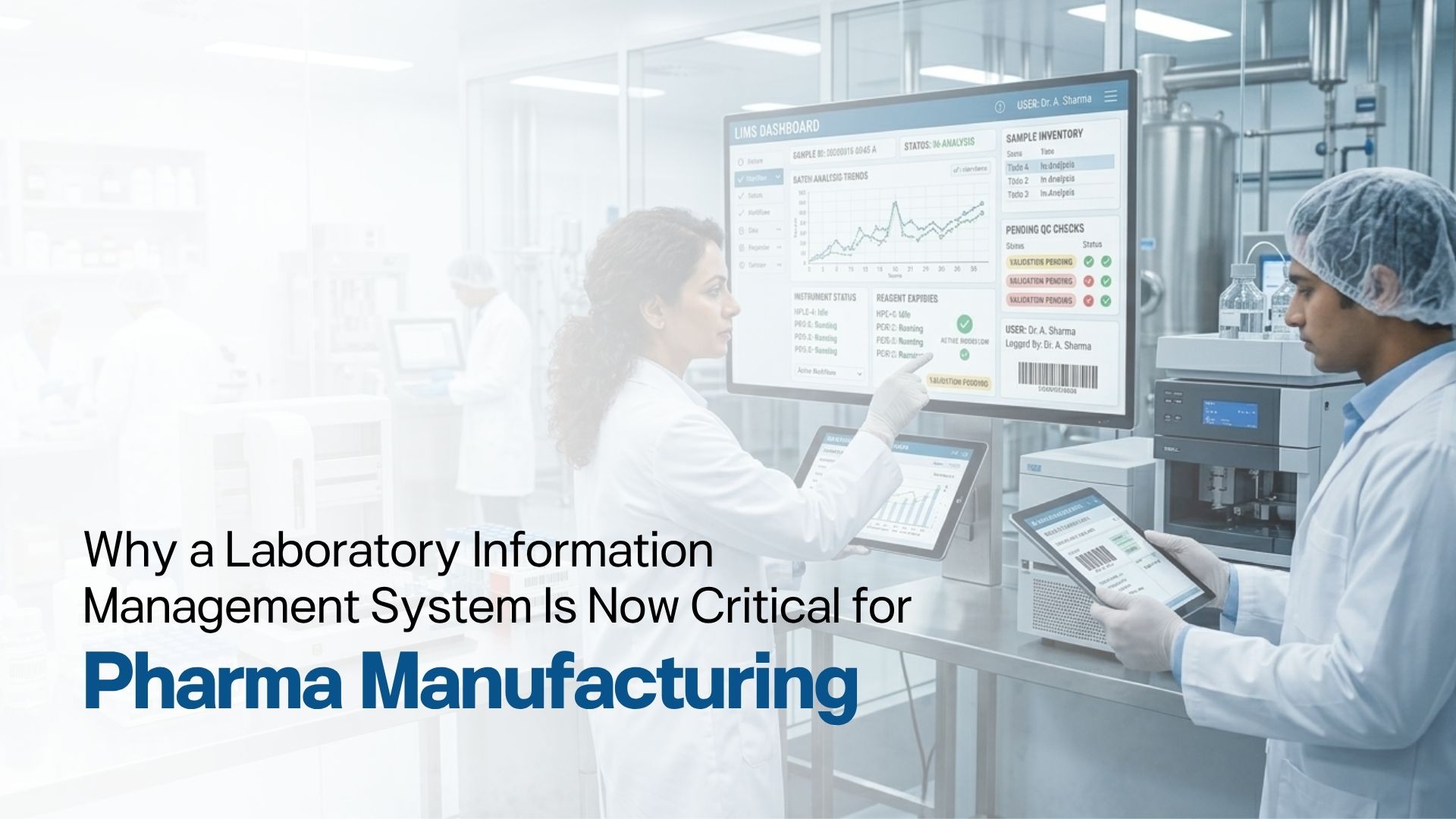
Why a Laboratory Information Management System (LIMS) Is Now Critical for Pharma Manufacturing
Pharmaceutical laboratories are at the heart of research, product quality control, regulatory compliance, and batch release decisions. Every day, thousands of samples move through quality control labs ranging from raw materials, in-process samples, finished products, stability samples, and environmental monitoring tests.
Yet in many pharma organizations, laboratory operations still rely on fragmented systems:
- Manual sample logging
- Excel-based tracking
- Paper worksheets and COAs
- Disconnected analytical instruments
- Disintegrated DMS and LIMS.
This is where a Laboratory Information Management System (LIMS) becomes indispensable.
What is a Laboratory Information Management System (LIMS)?
A modern Laboratory Information Management System (LIMS) is software that digitizes the entire lifecycle of laboratory operations from sample registration to results management, audit trails, reporting and regulatory compliance for any type of Laboratory, may it be R&D, QC or stability lab.For CXOs and VPs in pharma manufacturing, adopting a Laboratory Information Management System is not merely about IT modernization. It is about ensuring laboratory data integrity and precision, operational speed, and regulatory readiness in an increasingly demanding global market.
The Hidden Operational Inefficiencies in Traditional Pharma Laboratories
Despite significant investments, many laboratories still struggle with operational inefficiencies such as:
- Delayed sample tracking
- Manual entry of analytical results
- Expensive change controls due to paper based manual processes
- Time-consuming batch release documentation
- Difficulty in retrieving historical analytical data during audits
- Lack of integration between lab processes, instruments and documentation systems
According to industry studies on pharmaceutical digital transformation, laboratories spend nearly 30–40% of their time managing data rather than performing scientific analysis.
This is a critical inefficiency.
Without a centralized Laboratory Information Management System, valuable scientific talent often becomes burdened with administrative documentation rather than focusing on analytical insights.
How a Laboratory Information Management System Transforms Pharma Lab Operations
A Laboratory Information Management System provides a structured digital framework that connects every stage of laboratory workflows.
Key capabilities typically include:
- Digital sample registration and tracking
- Automated test assignment and workflow management
- Instrument data integration
- Electronic results entry and verification
- Audit trails and electronic signatures
- Regulatory compliance with 21 CFR Part 11 and ALCOA+ principles
- Reducing the need of documentation significantly by appropriately configuring lab processes and automated generation of documents by the system.
- Integration with production processes for IPQC sample collection and analysis
- Significant reduction or elimination of document change control saving on time, effort.
- Comprehensive solution supporting Every type of analysis in R&D, QC, Stability Environmental testing etc.
Instead of scattered data across paper logs, spreadsheets, and isolated systems, the Laboratory Information Management System creates a single, traceable, and validated digital environment.
This dramatically improves operational transparency and traceability during internal reviews or regulatory inspections.
LIMS vs Traditional Laboratory Documentation
| Feature | Traditional Lab | LIMS |
|---|---|---|
| Sample Tracking | Manual | Automated |
| Data Entry | Paper/Excel | Instrument / CDS integrated |
| Audit Trails | Limited | Full traceability |
| Data Retrieval | Slow | Instant |
| Documentation | Huge Effort | Almost NIL |
| Change Control | Very Expensive | Nil |
AI-Powered LIMS: The Next Evolution
The newest generation of Laboratory Information Management Systems is evolving beyond simple data management into intelligent laboratory platforms.
AI-enabled LIMS platforms can introduce capabilities such as:
Smart Sample Prioritization
AI algorithms can optimize testing queues based on batch release timelines and regulatory priorities.
Automated Data Validation
The Laboratory Information Management System can automatically detect anomalies or unexpected analytical results.
Faster Investigations
During OOS (Out-of-Specification) or deviation investigations, the system can quickly retrieve historical analytical data and testing conditions.
Predictive Quality Insights
AI tools integrated into the Laboratory Information Management System can identify patterns that indicate emerging process risks or quality variations.
This transforms the laboratory from a reactive testing function into a predictive quality intelligence center.
Operational Advantages of a Laboratory Information Management System (LIMS)
Implementing a LIMS delivers measurable benefits across multiple operational dimensions.
Faster Batch Release
Automated workflows accelerate result approvals and documentation.
Stronger Data Integrity
Every test result is traceable, timestamped, and securely stored.
Reduced Manual Errors
Instrument integration minimizes transcription errors.
Simplified Regulatory Inspections
Historical data retrieval becomes instantaneous during audits.
Improved Laboratory Productivity
Scientists spend more time on analysis rather than documentation.
Any Type Of Testing
Smart LIMS incorporates every type of testing – chemical, microbiological, environmental and so on.
Time and Effort Reduction
Time consumed in creating STP versions, filling AWR documents and collating data repeatedly for COA documentation is significantly reduced or eliminated.
Our experience shows that laboratory digitization with LIMS implementations can improve laboratory productivity by 20–35% while significantly reducing documentation errors.