India’s inspection outcomes are improving even as the comfort of advance preparation is diminishing.
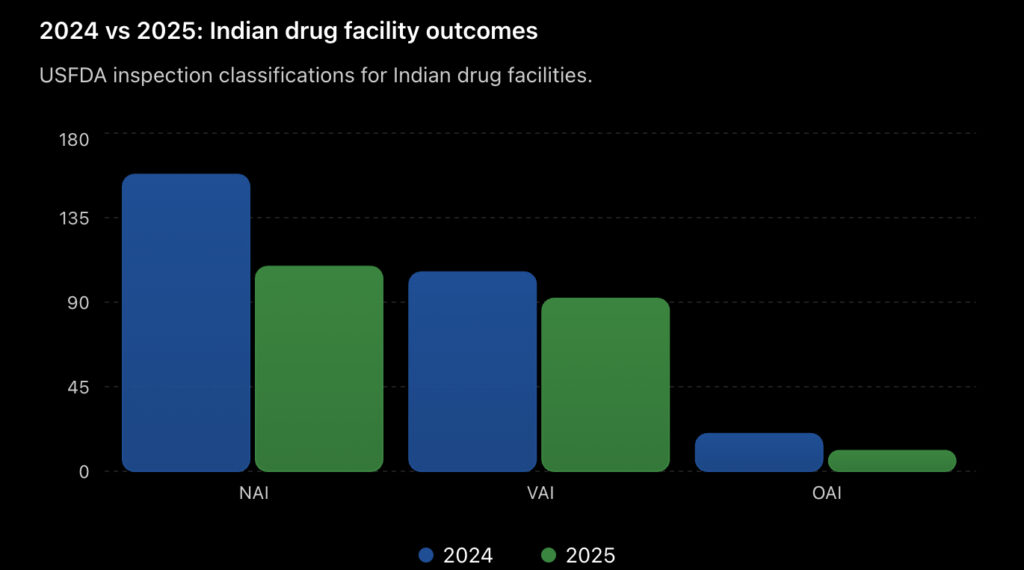
Indian pharma sites appear to be entering a more disciplined compliance phase. While total drug facility inspections in India declined from 284 in 2024 to 212 in 2025, the sharper fall in serious enforcement outcomes suggests improving inspection readiness across the sector. But the message is not comfort, it is caution. With OAI findings capable of blocking new US approvals and disrupting production, Indian pharma companies now need continuous compliance readiness, not inspection-time preparation.
The historical data shows three clear patterns:
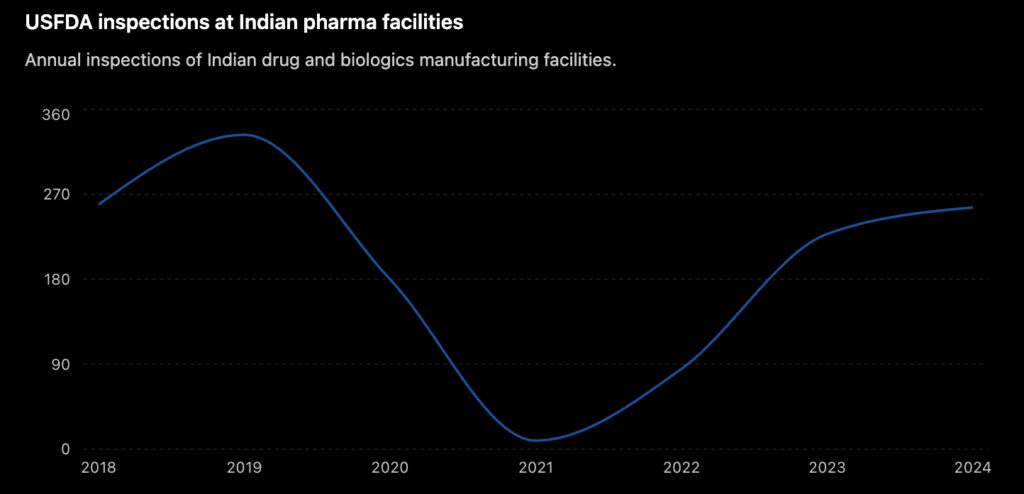
- Inspections have rebounded after the pandemic dip.
India saw USFDA inspections fall sharply to just 9 in 2021, but they recovered to 256 by 2024, almost back to the 2018 pre-COVID level of 259. - OAI rates have come down meaningfully.
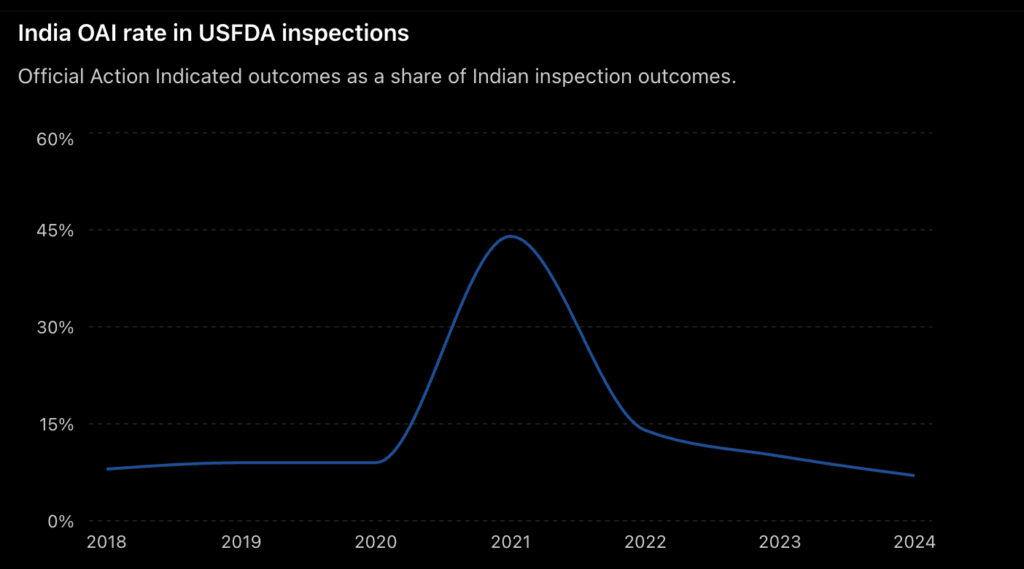
India’s OAI rate fell from 14% in 2022 to 7% in 2024. Longer-term commentary also indicates that OAI rates have moved down from the 15–20% range seen during CY2013–CY2017. - 2025 showed fewer inspections and fewer serious outcomes.
Drug facility inspections declined from 284 in 2024 to 212 in 2025. OAI cases fell from 20 to 11. This is positive, but it should not be read as softer scrutiny. It may also reflect risk-based targeting, stronger systems at larger companies, and changed inspection allocation.
Indian pharma’s USFDA numbers are moving in a direction that looks encouraging.
OAI cases are down. Inspection outcomes are cleaner.
The industry appears more mature than it was a decade ago.
The more important point is that this improvement is happening while the USFDA is moving towards a tougher inspection model: surprise or near-zero-notice inspections.
That changes how we should read the data.
Earlier, inspection readiness could depend in part on preparation cycles. Companies had time to organise files, review gaps, align teams, and prepare responses. Under surprise inspections, that preparation window shrinks sharply.
So the question changes from:
“Can we prepare well for an inspection?”
to:
“Can our normal operating day withstand inspection?”
What the numbers are really saying
The first data signal is that inspection volume has normalised after COVID.
India had 259 inspections in 2018 and 333 in 2019. The number collapsed during the pandemic, hitting just 9 in 2021. By 2024, inspections had recovered to 256.
This means the low-inspection pandemic phase is over. Indian pharma is again operating in a high-visibility regulatory environment.
The second signal is more positive.
India’s OAI rate has reduced from 14% in 2022 to 10% in 2023 and 7% in 2024. In 2025, the number of OAI cases in drug facilities fell from 20 to 11.
This suggests that many Indian pharma companies, especially larger export-focused players, have built stronger compliance systems over the last few years.
But the third signal is the most important.
Fewer OAI cases do not automatically mean lower regulatory pressure.
The USFDA is now expanding unannounced foreign inspections. That means the regulator is not only asking whether systems exist. It is testing whether those systems work without advance preparation.
Why surprise inspections matter
Surprise inspections convert compliance from an event into a daily operating standard.
In an announced inspection model, companies can temporarily improve coordination. In a surprise model, inspectors see how the system behaves naturally.
That is why this shift matters more than the inspection count alone.
Even if total inspections fluctuate year to year, the quality of scrutiny has changed. The inspection is no longer only a scheduled checkpoint. It becomes a real-time test of operating discipline.
For Indian pharma exporters, this is important because the US remains a major market. Cleaner inspection outcomes support confidence, approvals, and continuity. But surprise inspections raise the baseline expectation.
The industry is no longer judged solely on its ability to respond to an audit.
It is being judged on whether compliance is embedded in everyday operations.
The winners will be companies that do not depend on inspection preparation cycles. They will be companies where documentation, quality events, training,, batch & testing records, and audit trails etc. are already tracked in real time.
In the older model, companies prepared for inspection.
In the newer model, companies must operate as if inspection can begin any day.
For Indian pharma, the next compliance advantage will not come from better audit-room preparation.
It will come from systems that make every working day inspection-ready.
Samichinam brings Pharma Operations & compliance functions into one connected system.
DMS, Equipment Management, Laboratory, eBMR, & validation workflows, QMS and training management (LMS) work together seamlessly instead of operating in silos.
This gives Pharma manufacturers a real-time view of documents, quality events, training status, batch records, approvals and comprehensive audit trails. As a result, Teams do not have to rely only on manual follow-ups or last-minute audit preparation.
With automated alerts, role-based access, integrated workflows, and real-time tracking, operational and compliance gaps can be identified earlier and addressed before they become ‘audit observations’. This enables Pharma manufacturers to stay compliance-ready during daily operations, regulatory changes and, of course, for surprise inspections.