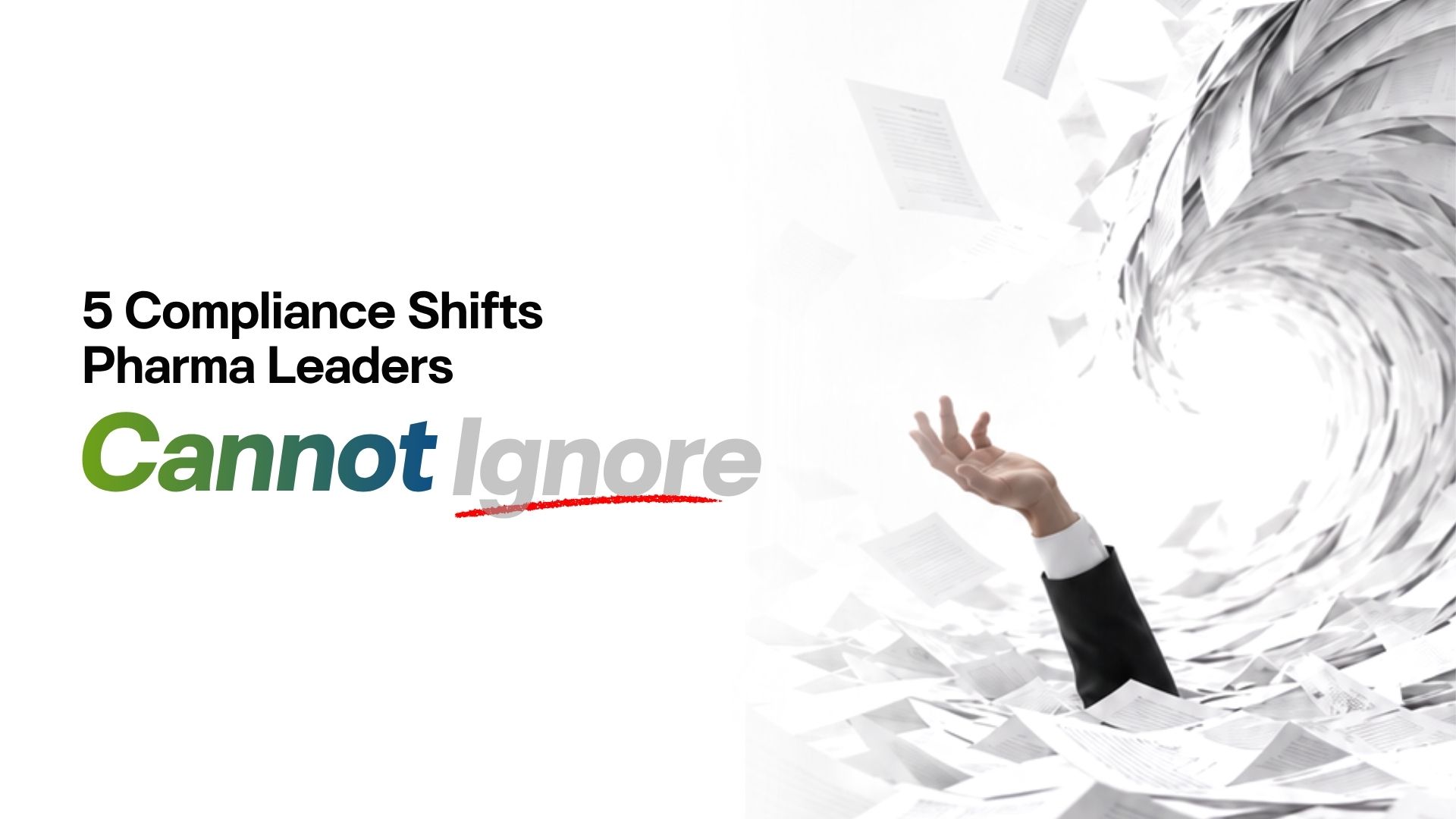
Pharmaceutical compliance is no longer limited to maintaining right documents for an upcoming audit. It now extends across laboratories, manufacturing, equipment, training, quality processes and every decision based on regulated data.
Most pharmaceutical organizations already follow defined procedures and data-integrity principles. The growing challenge is in keeping the execution data, and evidence connected , traceable and accessible .
As organization scales across products and sites, compliance needs to become connected , visible and consistent operational discipline and not a function in isolation. Here are five shifts shaping that transition.
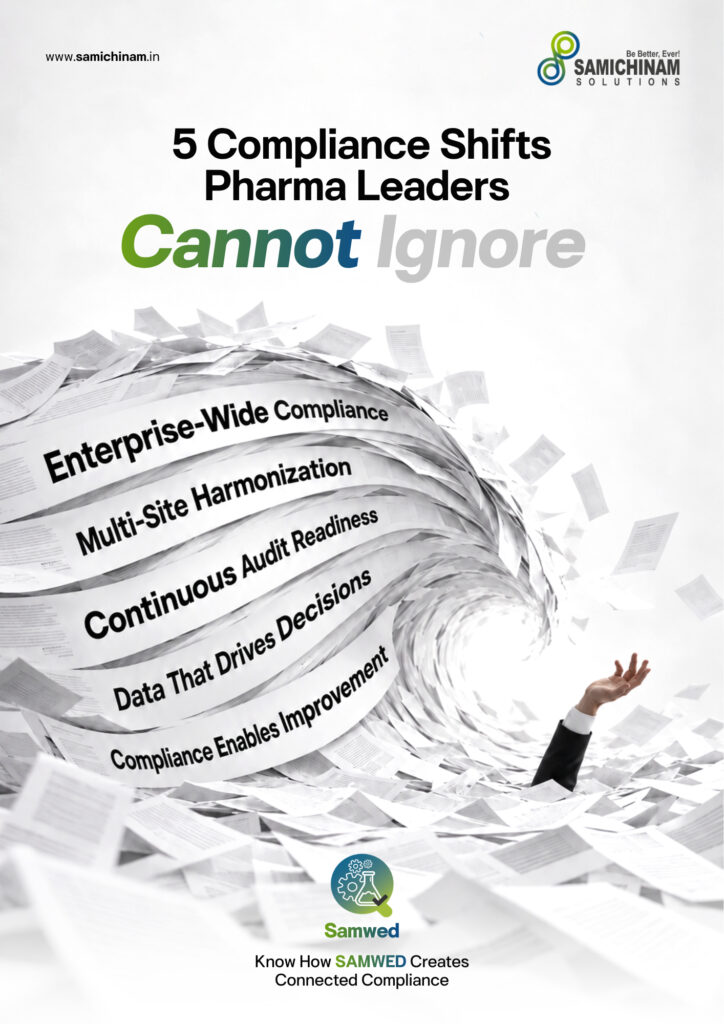
1. Compliance Must Be Managed Across the Enterprise
A deviation may begin in manufacturing but involve an equipment record, laboratory result, revised SOP, training history and CAPA. Every department may be managing activities and creating records of its own function. The greater challenge is maintaining the context and traceability within those connected functions.
Enterprise-wide compliance requires connected workflows and consistent data governance. Quality, laboratory, manufacturing, engineering and training teams should be able to work within their individual processes while contributing to one traceable data flow.
This creates clearer accountability and gives better visibility to management into how an issue in one function can affect another.
2. Multi-Site Compliance Needs Harmonization, Not Just Standardization
Global and multi-site pharmaceutical companies often operate with different local practices, products and regulatory expectations. Completely independent processes create inconsistency, while rigid standardization may not accommodate legitimate site-level needs.
The better approach is to establish common governance while allowing controlled workflow configuration.
Core quality principles, approval hierarchies and data-integrity requirements can remain consistent across the organization. At the same time, workflows can be configured for region specific regulatory requirements, products, responsibilities and risk levels.
This creates harmonization without forcing every site into an impractical one-size-fits-all model.
3. Audit Readiness Must Become a Continuous State
Inspection preparation can consume considerable time when teams must locate documents, reconcile spreadsheets and reconstruct the sequence of past decisions. This has a direct impact on productivity. If people have to stop their work to prepare and be ready for an audit, it’s LOSS.
Continuous audit readiness changes this model.
When records are generated during execution, every approval, revision, exception and action becomes part of a traceable digital history. Teams can retrieve current and historical documents, training records, investigations, equipment information and laboratory evidence when required.
This reduces both people behind the scene and last-minute evidence hunting. That, in turn, allows employees to focus on explaining the process rather than searching for the record.
4. Data Has Value Only When It Supports Decisions
Pharmaceutical plants generate large volumes of data, but more data does not automatically create better compliance.
The data must be structured, contextual,accessible and reusable.
Equipment Data is useful only when the schedules created for calibration, PM, cleaning etc and the logbooks of usage help in actual production planning to enhance productivity.
Material Testing results from Lab, if & only if, can be used in finding patterns & quality of materials received by Vendors, vendor qualification and requalification becomes a decision backed by data.
When a user does not need to recreate or refill data for APQR and can just fetch the data from manufacturing batches &/ or lab test reports, that’s reusability.
The list of such examples can be extended across any function of the plant for data that’s structured, accessible and reusable.
Real-time dashboards and predictive analysis can help teams identify emerging risks before they become deviations or audit findings. Generative AI may assist users in improving inputs or understanding information, while predictive AI can help detect patterns and potential variance. Both support human decision-making rather than replacing quality judgement.
5. Compliance Should Enable Improvement, Not Obstruct It
Compliance and innovation are often treated as competing priorities. In practice, the way compliance processes are designed can have a significant impact on how easily an organization can introduce change. Paper-heavy changes require repeated document preparation, circulation, approval and training follow-up. Disconnected systems make impact assessment slow and increase the risk of missing a dependent action.
Configurable digital workflows help organizations evaluate change systematically, route it to the right people and maintain a complete implementation trail. This creates an opportunity to make compliance part of the mechanism for controlled improvement, rather than treating it as an administrative layer around operations.This allows new products, processes, equipment and markets to be introduced with stronger control and less administrative friction as the data across organization becomes structured, connected and reusable.
How SAMWED Creates Connected Compliance
Rather than a collection of isolated applications, Samwed is the Product Development & Execution Platform. It is the Process Engine enabling Structured, Connected & Reusable Knowledge
Its modules cover Document Management, Equipment Care and Smart Logbooks, Laboratory operations through LIMS++, LES++, ELN and Environmental Monitoring,Manufacturing through eBMR++ and eBPR++, Store Management & Inventory Tracking, Quality Management, System Validation and Training management.
Organizations can begin with the processes they need the most and increase their level of digitalization progressively. As more modules are introduced, information remains connected across operations.
Configurable workflows, electronic records, audit trails, real-time dashboards and AI-supported assessments help teams improve data quality, traceability and risk visibility. Explore the SAMWED Suite
Compliance Must Work While the Plant Is Working
A strong compliance system should not become visible only during an audit. It should guide daily execution, improve decisions and help teams detect risks earlier.
The next level of pharmaceutical compliance is not more documentation. It is structured, connected,reusable, reliable and decision-ready information.