Pharmaceutical companies are investing heavily in,, DMS,LIMS, eBMR, QMS and other compliance systems.
Yet months after implementation, teams are still maintaining Excel trackers. Documents are printed for review. Users create unofficial workarounds because the approved workflow is too complicated.
The system is technically live.
Operationally, nothing has transformed.
This is the elephant in the room: many pharma compliance software projects do not fail because the technology is inadequate. They fail because poor processes are digitized without being questioned.
In regulated environments, digital transformation is not achieved by putting an existing process onto a screen. It requires understanding the process, questioning unnecessary complexity, designing the right workflow, and then using technology to make that workflow practical, controlled and measurable.
That is where the difference between software implementation and digital transformation becomes clear.
Digital Paper Is Still Paper Thinking
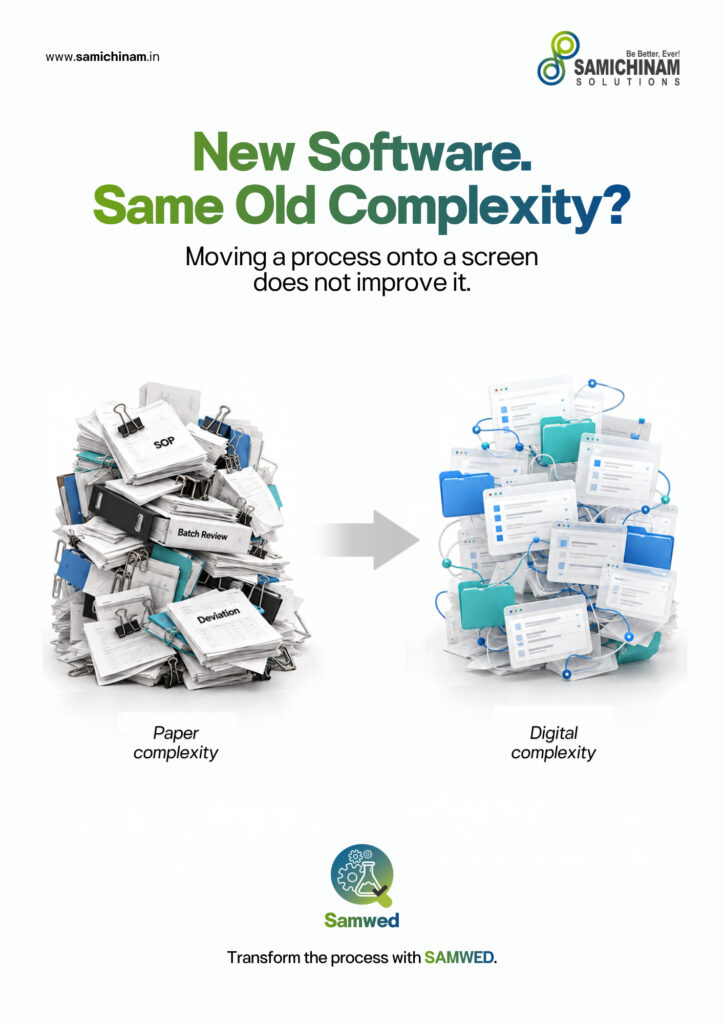
One of the biggest implementation mistakes is recreating every paper form, field and approval inside the software.
If a paper process requires twelve signatures, the digital workflow is configured with twelve approvals. If three departments maintain similar records, three digital versions are created. If an SOP contains unnecessary checks, the same checks are hard-coded into the system.
The process becomes electronic, but it does not become better.
This is not digital transformation. It is paper-based thinking displayed on a screen.
A good implementation should ask why every field, approval and handover exists If the answer is simply, “Because this is how we have always done it”, that should trigger a conversation, not automatically become a configuration requirement.
The right digital platform should make it possible to have that conversation and then configure the process accordingly.
Go-Live Is Treated as the Finish Line
Most implementation teams are measured on timelines:
Was the configuration completed?
Was validation closed?
Did the system go live?
Far fewer are measured on outcomes:
Did deviation closure become more predictable?
Did laboratory turnaround time improve?
Did documentation effort reduce significantly?
Can QA retrieve audit evidence faster?
Did users stop maintaining parallel records?
Is information available when decisions need to be made?
Are managers getting better visibility into exceptions and risks?
A project can meet every implementation milestone and still fail to deliver the business objective.
Software activation is not transformation. Real success begins when people use the system correctly without needing shadow spreadsheets, paper notes and constant manual follow-up.
Validation Is Sometimes Used to Protect Poor Decisions
Validation is essential in a regulated environment. But it is sometimes used as an excuse to resist sensible improvement.
Teams hesitate to simplify workflows because changes may require additional testing and documentation. Inefficient configurations remain untouched because the system has already been validated. Temporary workarounds gradually become permanent operating practices.
Validation should prove that the system is fit for its intended use. It should not preserve an implementation that is visibly unfit for daily work. As a corollary, the system implemented should ensure end users that the validation of any change in configuration becomes organically easy and not an effort everyone is afraid of.
If users must work outside the system to complete the process, the validated state exists more confidently on paper than in reality.
Compliance Software Is Often Implemented as an IT Project
IT plays a critical role, but compliance transformation cannot be owned by IT alone.
The people who understand deviations, investigations, laboratory execution, equipment usage, batch review and training qualification must shape the workflows. More importantly, they must be empowered to challenge their existing processes.
When implementation becomes a technical exercise, discussions focus on fields, screens, servers and access rights. The more important questions are missed:
- What decision should this workflow enable?
- What evidence is genuinely required?
- Where does the process normally get delayed?
- What information should flow automatically?
- What risk should the system help prevent?
- Who needs visibility before the issue escalates?
Technology can automate a process. It cannot decide whether that process deserves to exist in its present form.
Too Many Point Solutions Create Digital Silos
A separate application is often purchased for every operational problem.
One system manages documents. Another takes care of training. A third handles deviations. Laboratory information sits elsewhere. Equipment records remain on another platform. Manufacturing continues with a combination of software and paper.
Each department becomes digitally enabled in isolation, while the organization becomes more disconnected and this in turn affects the efficiency and productivity.
A deviation investigation still requires evidence from multiple systems. An SOP revision may not automatically trigger the correct training. An equipment issue may not be visible when reviewing an affected batch.
Digitizing silos does not remove silos. It makes them more expensive.
User Resistance Is Usually a Design Signal
When employees resist a system, management often concludes that people do not want change.
Sometimes that is true. However, often, resistance is telling us something useful.
The workflow may require too many clicks. Screens may not match actual execution. Users may enter the same information repeatedly. The system may have been designed around an idealized process rather than what happens on the plant floor.
Training cannot permanently compensate for poor usability.
If experienced employees consistently need offline notes and workarounds, the implementation should be examined before the users are blamed.
What a Strong Implementation Looks Like
A successful compliance software implementation begins with the desired quality and business outcome. The workflow is then configured around the evidence, decisions and controls required to achieve it.
It should:
- Simplify and harmonize before automating
- Connect related quality and operational processes
- Capture information during execution
- Eliminate duplicate and retrospective entry
- Provide role-relevant visibility
- Allow practical configuration without uncontrolled customization
- Measure adoption and outcomes after go-live
- Improve continuously without weakening validation
SAMWED: Implementation Around Objectives, Not Old Forms
SAMWED is designed as a unified Product Development and Execution Platform, a business process engine covering Document Management, Training, Laboratory, Equipment, Manufacturing, Stores, Quality Management and System Validation.
Its goal-centric configuration starts with what the process must achieve. Workflows are structured around relevant data capture, risk assessment, accountability and decision-making rather than blindly reproducing paper formats.
Organizations can begin with priority processes and expand at a practical pace. Because the modules operate within one connected environment, every new stage of digitalization strengthens the wider information flow instead of creating another isolated system.
The Question Pharma Leaders Must Ask
The industry does not need more software that is technically implemented but operationally avoided.
Before approving the next digital compliance project, leaders should ask one uncomfortable question:
Are we transforming the process, or merely converting our existing inefficiencies into electronic form?
That answer will determine whether the investment creates Pharma 4.0 or simply produces a more expensive version of paper.