Pharmaceutical compliance is ultimately about protecting product quality, patient safety and the reliability of every decision made across the product lifecycle.
Pharma companies already operate through approved procedures, trained personnel and established data-integrity principles such as ALCOA++. The challenge is ensuring that all these controls work together and that the evidence supporting them remains accessible, consistent and traceable.In practice, relevant information may be distributed across paper records, spreadsheets, instruments and multiple software platforms.
This is where pharmaceutical organizations have an opportunity to move beyond documentation towards greater operational visibility and control.
Compliance Extends Across the Entire Operation
Quality Assurance alone is not accountable for Compliance. It begins with material receipt and continues through equipment usage, laboratory testing, manufacturing, batch release, storage and distribution.
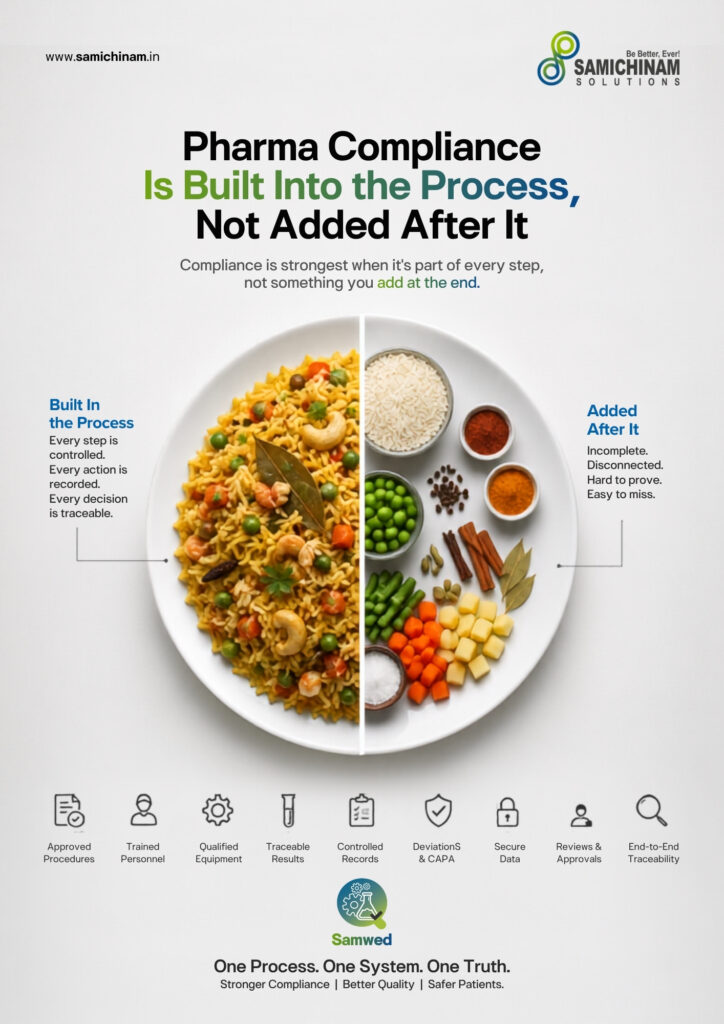
It depends on several connected controls:
- Approved and latest version of procedures
- Qualified and appropriately trained personnel
- Calibrated and maintained equipment
- Traceable samples and laboratory results
- Controlled manufacturing records
- Timely management of quality processes
- Secure electronic records and audit trails
- Review and approval by authorized personnel
- Complete product and process traceability
A weakness in any of the aspects can influence the quality and compliance of the final product.
Where Compliance Becomes Difficult
Pharmaceutical operations produce large volumes of regulated information. As organizations grow, add products, expand facilities and adopt new technologies, managing the relationships between this information becomes increasingly important. When the information is spread across departments and formats, several practical challenges emerge.
Teams may struggle to confirm which SOP version was effective during an activity. Training status may not be visible when assigning work. Equipment availability may be checked separately from its calibration or maintenance status. Laboratory, manufacturing and quality records may need to be reconciled manually before batch release.
These are not necessarily failures of individual systems or departmental procedures. They are challenges associated with maintaining continuity of information across complex operations.
When connections are limited, employees spend additional time locating records, verifying information and establishing relationships between activities. This can increase administrative effort and make timely decision-making more difficult.
Documentation Alone Does Not Prove Control
An organization may possess every required record and still struggle during an audit.
Inspectors do not only ask whether a document exists. They ask evidence of:
- Who performed the activity?
- Were they qualified at that time?
- Which procedure did they follow?
- Was the equipment fit for use?
- Who reviewed and approved the record?
- Were any changes or deviations associated with it?
- Can the complete history be retrieved?
Compliance therefore requires more than record availability. It requires relationships between records to remain clear, accurate ,traceable and retrievable at any point of time.
Four Foundations of Sustainable Pharma Compliance
Controlled processes
Every activity should follow an approved workflow with defined responsibilities, reviews, approvals and escalation paths.
Reliable data
Information should be attributable, legible, contemporaneous, original, accurate, complete, consistent, enduring and available throughout its lifecycle.
Connected evidence
Documents, training, equipment, laboratory, manufacturing and quality records should provide one continuous evidence trail.
Continuous visibility
Management should be able to identify patterns in delays, exceptions, recurring deviations and emerging trends before they become larger compliance risks.
Moving from Compliance Records to Compliance Intelligence
Traditional systems indicate what has already happened. Connected digital systems also help them understand what requires attention now. These systems use connected operational information to improve the quality and timeliness of decisions.
Real-time dashboards can highlight overdue CAPAs, pending reviews, training gaps, equipment status and laboratory workloads. Trend analysis can reveal recurring quality events across batches, products or sites. Predictive AI can identify developing patterns and potential risks, while generative AI can assist users in improving the completeness and clarity of information entered into the system.
The technology supports faster and better-informed decisions. Final quality judgement remains with qualified personnel.
How SAMWED Connects Compliance Across the Plant
SAMWED provides a unified Pharma 4.0 process engine covering Quality Management, Document Management, Training Management, Equipment Care and Smart Logbooks, Laboratory operations through LIMS++, LES++, ELN and Environmental Monitoring, Manufacturing through eBMR++ and eBPR++, Store Management and System Validation.
Its configurable workflows allow organizations to align digital execution with their approved processes. Electronic records, controlled templates, e-signatures, audit trails and real-time dashboards improve traceability without creating parallel documentation.
Because the modules work together, a process can connect the applicable document, trained person, qualified equipment, executed activity, generated result and subsequent quality decision.
Organizations can begin with selected processes and expand their digitalization progressively, without losing the advantage of a unified system.Explore the SAMWED Suite
Compliance Should Be Visible in Every Process
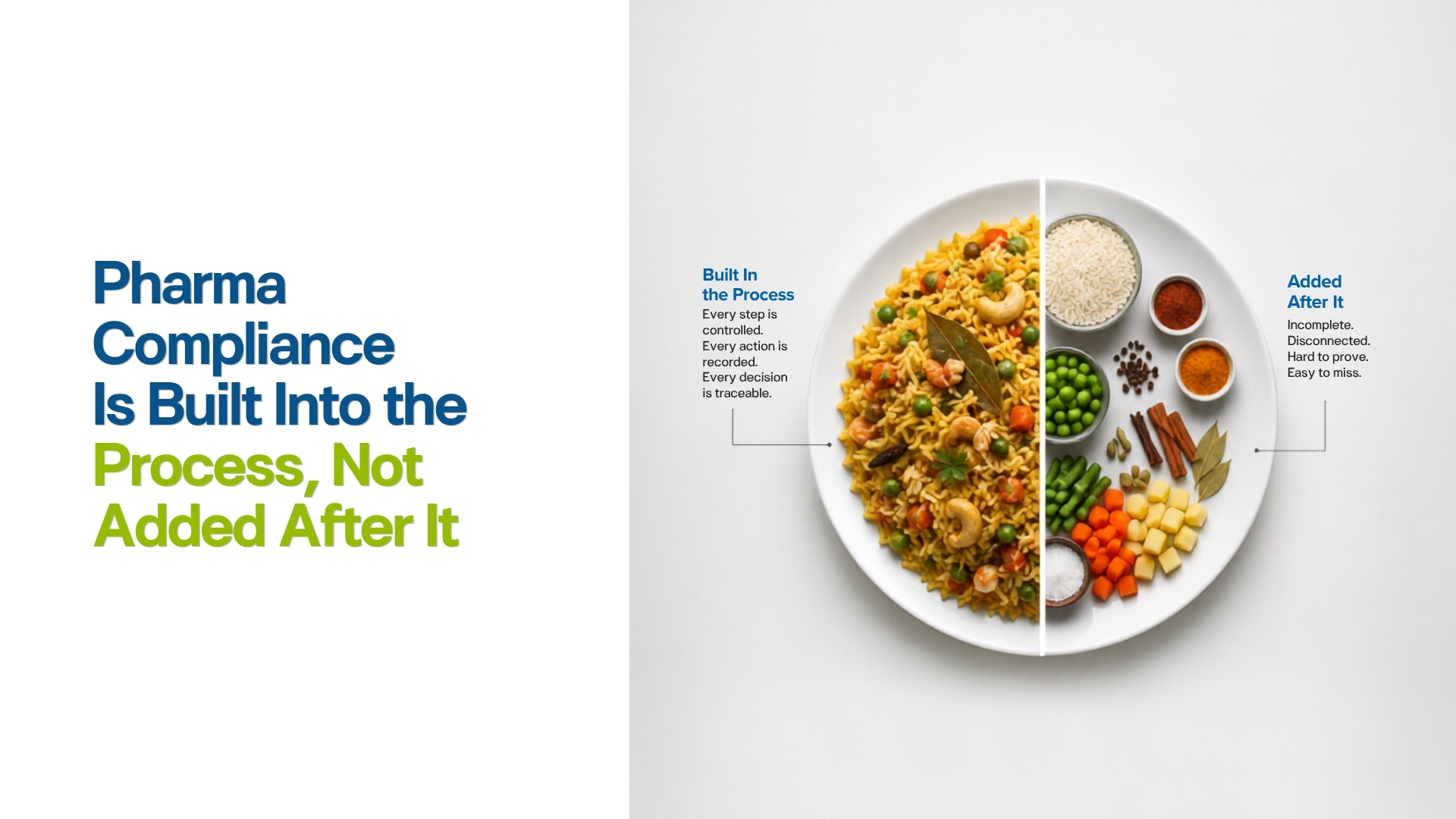
Strong pharmaceutical compliance is not created through paperwork alone. It is created when approved processes are executed consistently, responsibilities are clearly defined andthe supporting evidence is generated automatically along the way.
The next stage of pharmaceutical digital transformation is about connecting people, processes and information to create greater visibility, stronger traceability and better-informed decisions.
When people, processes and data remain connected, compliance becomes easier to execute, verify and continuously improve.