
Traditionally, compliance evolved in predictable cycles.
A new guideline would be issued. Companies would assess gaps.The implementation plan would be prepared after this.
Implementation would follow over months or even years. Audits and inspections would subsequently assess and validate effectiveness of the implementations. .
Today, that cycle is compressing and the challenge is becoming more and more complex.
Multiple regulatory developments, evolving quality expectations and emerging technology governance requirements are converging within relatively short periods. Each brings its own implementation requirements, but together they can create significant demands on resources, systems and processes of an organization.
These are Compliance Bursts – periods when multiple compliance expectations emerge, evolve or reach critical implementation milestones around the same time.
Take the timeline in two areas, for instance:
2024–2025: GMP and Manufacturing Readiness
- Revised Schedule M in India: The revised GMP requirements notified in December 2023 introduced enhanced expectations relating to pharmaceutical manufacturing facilities, premises, equipment, quality systems and documentation.
- Organizations needed to assess and strengthen relevant infrastructure, equipment, environmental controls, quality systems, personnel training and documentation practices to align with the revised requirements
- Rather than a multiyear change implementation, large manufacturers had a six-month timeline, while eligible small and medium manufacturers received additional time, including a conditional extension up to December 31, 2025.
- USFDA inspection intensity remains high, with hundreds of inspections annually for Indian facilities, and warning letters often requiring remediation plans within 15–30 days.
- EU regulators are increasing their focus on data integrity, with repeat observations leading to import alerts or supply disruptions.
2025–2026: AI and Digital Governance
- Regulatory bodies such as the FDA are formalising expectations for AI use in regulatory decision-making, introducing risk-based validation and credibility assessment frameworks.
- Companies must demonstrate explainability, validation, and human oversight for AI-assisted processes—moving beyond traditional system validation into algorithm-level accountability.
- Documentation requirements are expanding significantly, with expectations for lifecycle management of AI models, version control, and auditability of outputs.
- What previously required periodic validation updates may now require continuous monitoring and documentation updates as models evolve.
2025 onward: Data Transparency and Enforcement
- Regulatory oversight is also becoming increasingly data-informed.
- Regulatory agencies use inspection histories, complaints, quality signals, adverse event information and other available data to support risk-based oversight and enforcement decisions.
- For pharmaceutical companies, this reinforces the importance of maintaining reliable information and consistent compliance practices across facilities and operations.
- Some important implications include:
- Quality and compliance information needs to remain accurate, traceable and readily retrievable.
- Recurring observations and quality trends require systematic assessment.
- Corrective actions should address underlying causes and demonstrate sustained effectiveness.
- Organizations operating across multiple markets need visibility into applicable regulatory expectations and their implementation status.
- Compliance is no longer simply about preparing for the next scheduled inspection. It is about maintaining the ability to demonstrate control whenever the need arises.
The Impact on Indian Pharma Exporters
For exporters supplying regulated markets like the US and Europe, these bursts create a new operating reality.
The question is no longer:
“Are we compliant today?”
It is:
“How quickly can we adapt to the fast changing expectations?”
This shift has several implications:
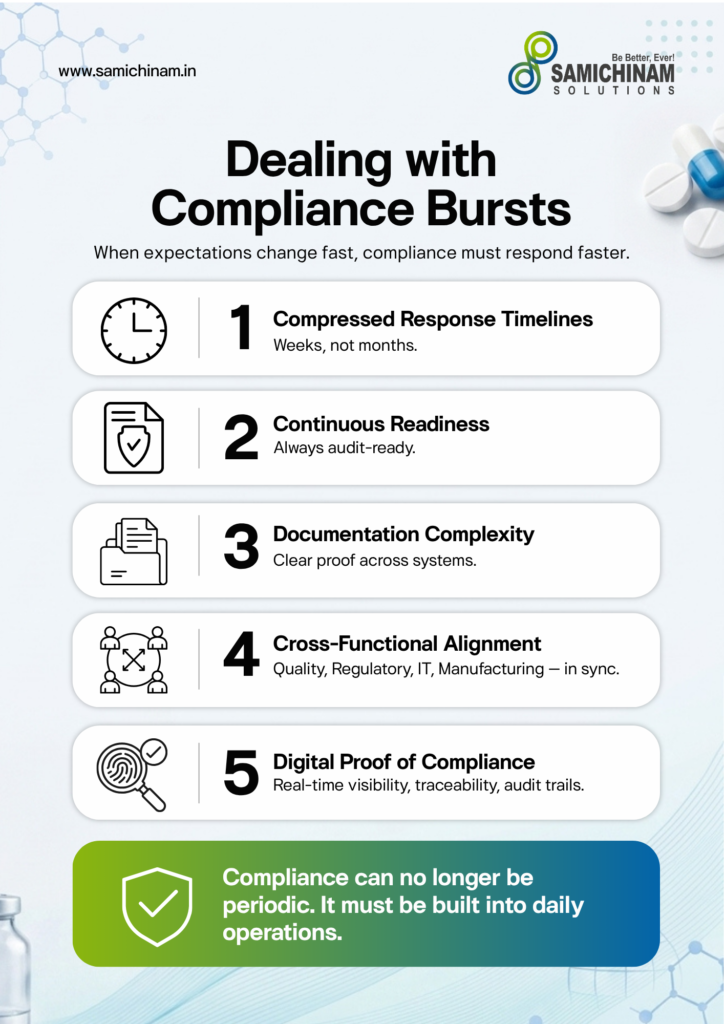
1. Compressed ImplementationTimelines
Regulatory changes that once allowed months of preparation now demand action within weeks. Delayed responses increase audit risk and market exposure.Ability to prioritize has become crucial.
2. Continuous Readiness vs Periodic Preparation
Compliance can no longer be treated as an event. It must be embedded into daily operations, with systems that are always audit-ready.
3. Cross-Functional Alignment
Quality, regulatory, IT, manufacturing, and commercial teams must operate in sync. A gap in one area can trigger risk across the entire organization.
4. Digital Proof of Compliance
Manual tracking and fragmented systems cannot keep pace. Digital systems that abide by ALCOA++ principles and provide real-time visibility, traceability, and audit trails are becoming essential.
Readiness as a Growth Strategy
For Indian pharma exporters, compliance is no longer just a regulatory requirement.
It is becoming a competitive differentiator. It can influence business continuity, customer confidence and the ability to pursue opportunities in regulated markets.
Companies that establish mechanisms to respond quickly to compliance bursts will enter and sustain a presence in regulated markets more effectively. They will also:
- Manage implementation activities with greater predictability.
- Reduce avoidable delays and remediation effort.
- Reduce audit findings and remediation costs
- Build stronger trust with global regulators and partners by demonstrating consistent quality oversight to regulators and business partners.
- Accelerate product approvals and market access
In contrast, companies that struggle to adapt will face delays, increased scrutiny, and potential loss of market opportunities.
In global pharma, readiness is becoming a growth strategy.
And in a world defined by compliance bursts, the companies that stay ready will be the ones that move forward.
Samichinam is working as a partner to several Pharma companies in navigating the compliance bursts effectively. By connecting document management, quality management, training, equipment care, laboratory operations and manufacturing workflows, SAMWED helps organizations manage compliance-related activities within a common business development and process engine.
We also work closely with pharmaceutical teams to understand their operational challenges and explore practical approaches to digital transformation.
If your organization is currently navigating a regulatory change or preparing for upcoming compliance requirements, we would be happy to exchange perspectives and share relevant implementation experiences.
Because in an environment of compliance bursts, the advantage lies not simply in responding to change, but in being prepared to manage it.
Drop us an email to know real-life examples of such partnerships . We will be happy to share.