A pharmaceutical company invests in a Document Management System (DMS). The implementation is successful, employees are trained, and document control becomes more efficient.
A year later, the company wants to optimize the DMS process in place and also wants to digitise its Quality Management System (QMS). The laboratory needs LIMS, and manufacturing is considering electronic Batch Manufacturing Records (eBMR,eBPR).
Each requirement brings another software proposal, licensing discussion, implementation project and integration challenge.
Five years later, the company has several digital systems, each serving an important purpose. But the cumulative cost of owning and managing these systems may be considerably higher than originally anticipated.
This is where Total Cost of Ownership (TCO) becomes an important consideration when planning digital transformation .
What Does Software Really Cost Over Five Years?
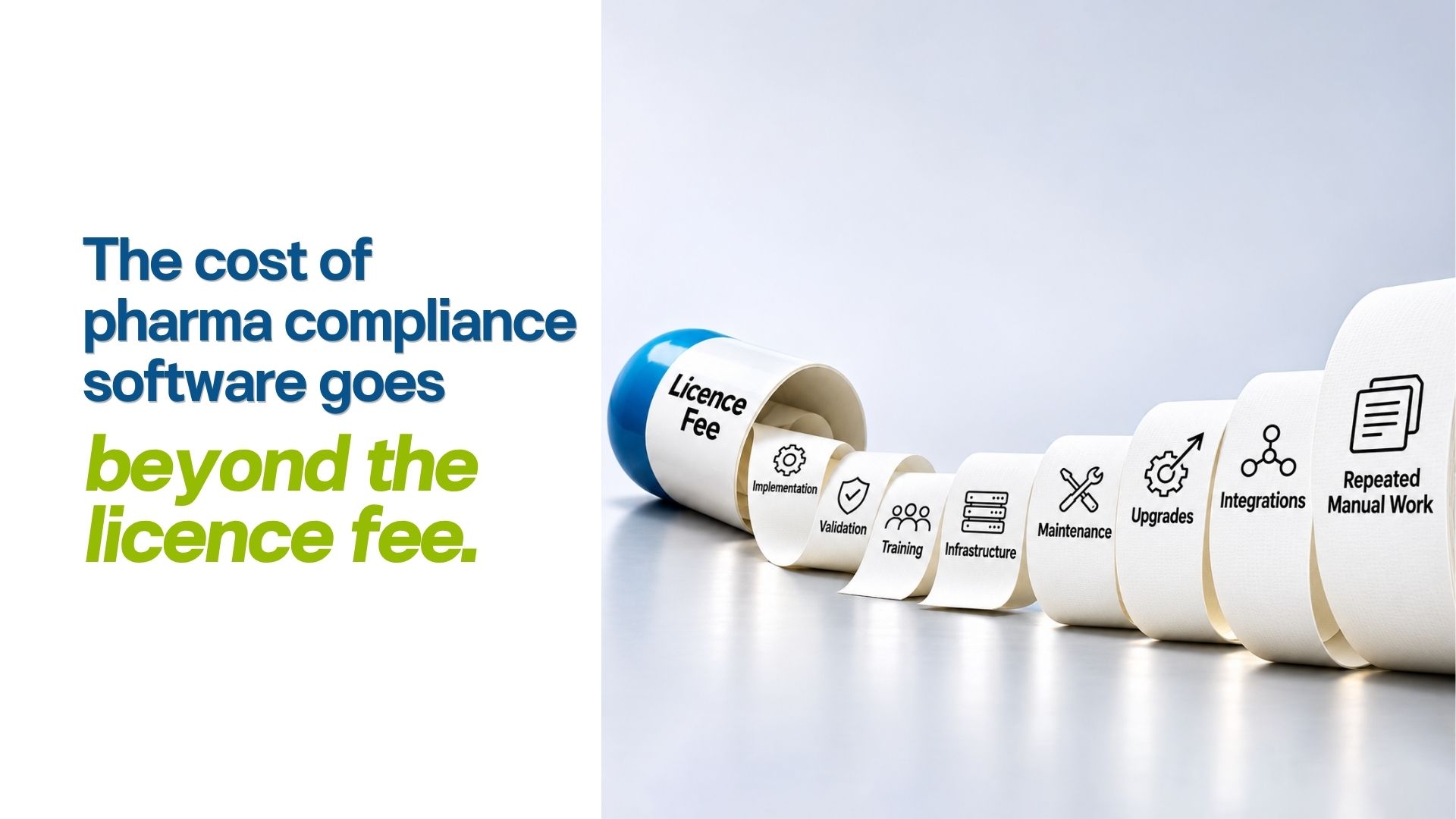
The initial licence fee is only one component of software expenditure.
Implementation, validation, employee training, infrastructure, maintenance, upgrades and technical support contribute to the total cost of ownership of pharma compliance software.
When companies purchase separate applications for different departments, these expenses do not simply add up; they can compound .
Each system may require its own maintenance arrangement, upgrades, validation activities and integration with other applications.. Basic configuration data, such as user, product and site masters, may need to be maintained across multiple systems.
Employees may also spend considerable time transferring information between systems and reconciling records.Furthermore, a change in one system can affect its integrations with other applications, potentially triggering additional change requests, testing and validation activities.These costs accumulate throughout the software’s operational life, often without being visible in the original purchase decision.
When Business Growth Leads to Repeated Software Investments
Digital transformation rarely happens all at once.
A pharmaceutical manufacturer may begin with DMS, introduce equipment management the following year and subsequently digitise quality(QMS), laboratory and manufacturing operations.
The challenge arises when every new requirement demands an independent software investment.
Beyond additional licensing costs, the organisation may need to establish new infrastructure, validate another system, train or recruit employees and develop and maintain integrations.
A more sustainable approach is to invest in a software foundation that can accommodate expanding operational requirements.
This allows companies to build on their existing investment instead of repeatedly establishing and maintaining separate software environments.
How Samwed Helps Reduce Total Cost of Ownership
Samwed, developed by Samichinam Solutions, is a unified business process engine designed to support pharmaceutical business processes across their lifecycle .
Its one-time platform licensing approach allows organisations to establish a common software foundation and add functional modules as their requirements evolve.
A company may begin with DMS and subsequently introduce QMS, LIMS++, eBMR++, Training Management or Equipment Care within the existing Samwed environment.
This approach offers four important financial advantages.
1. Greater value from the initial investment
Additional modules can build on the existing platform, reducing the need to repeatedly invest in independent software foundations and associated validation activities .
Module-specific implementation and commercial costs may still apply, but organisations can leverage their existing platform investment as they expand .
2. Reduced integration and maintenance effort
Connected processes within a common platform can reduce dependence on multiple standalone applications and the interfaces required to exchange information between them.
Common data and process configurations can also reduce duplication of administrative effort, simplify maintenance and minimise the impact of changes across interconnected applications.
3. Lower effort in adapting processes
Samwed’s configurable workflows allow organisations to accommodate evolving operational requirements with less dependence on extensive custom development, Business processes can be adapted through configuration while retaining the necessary change control, testing and validation
This can significantly reduce the effort and cost involved in accommodating business changes over the software’s operational life .
4. Reduced Dependence on Specialised Resources and Manual Documentation
Samwed is designed with a low learning curve, making it easy to learn and use to users across organisational levels, from CXOs and department heads to operators.
Its configurable, no-code approach reduces dependence on specialised technical resources for routine process configuration and modifications. Similarly, its intuitive interface helps simplify end-user adoption and ongoing operations.
Additionally, Samwed can generate documentation such as master records, specifications, STPs and various reports directly from captured and processed data, based on configured templates and business rules.
This reduces repetitive documentation preparation, manual data compilation and associated review effort, allowing employees to focus on higher-value activities.
Together, these capabilities can help pharmaceutical companies manage software expenditure more efficiently as their operations expand.
The Real Question Is What Happens After Implementation
Two software solutions may have similar initial prices but very different long-term ownership costs.
One may require additional investments every time the organisation modifies a business process or expands its digital operations. Another may allow new capabilities to be introduced by leveraging an existing platform.
A meaningful TCO evaluation should therefore look beyond the initial licence fee and implementation cost. . It should consider the next three to five years, including anticipated expansion, maintenance, integrations,upgrades, validations and ongoing operational effort.
For pharmaceutical companies planning long-term digital transformation, Samwed offers an approach that makes better use of the initial platform investment while supporting evolving business requirements and future growth.
The true cost of pharma compliance software becomes clear over the years it is used, expanded, adapted and maintained.
Discover how Samwed can help your organisation manage long-term software ownership costs.