
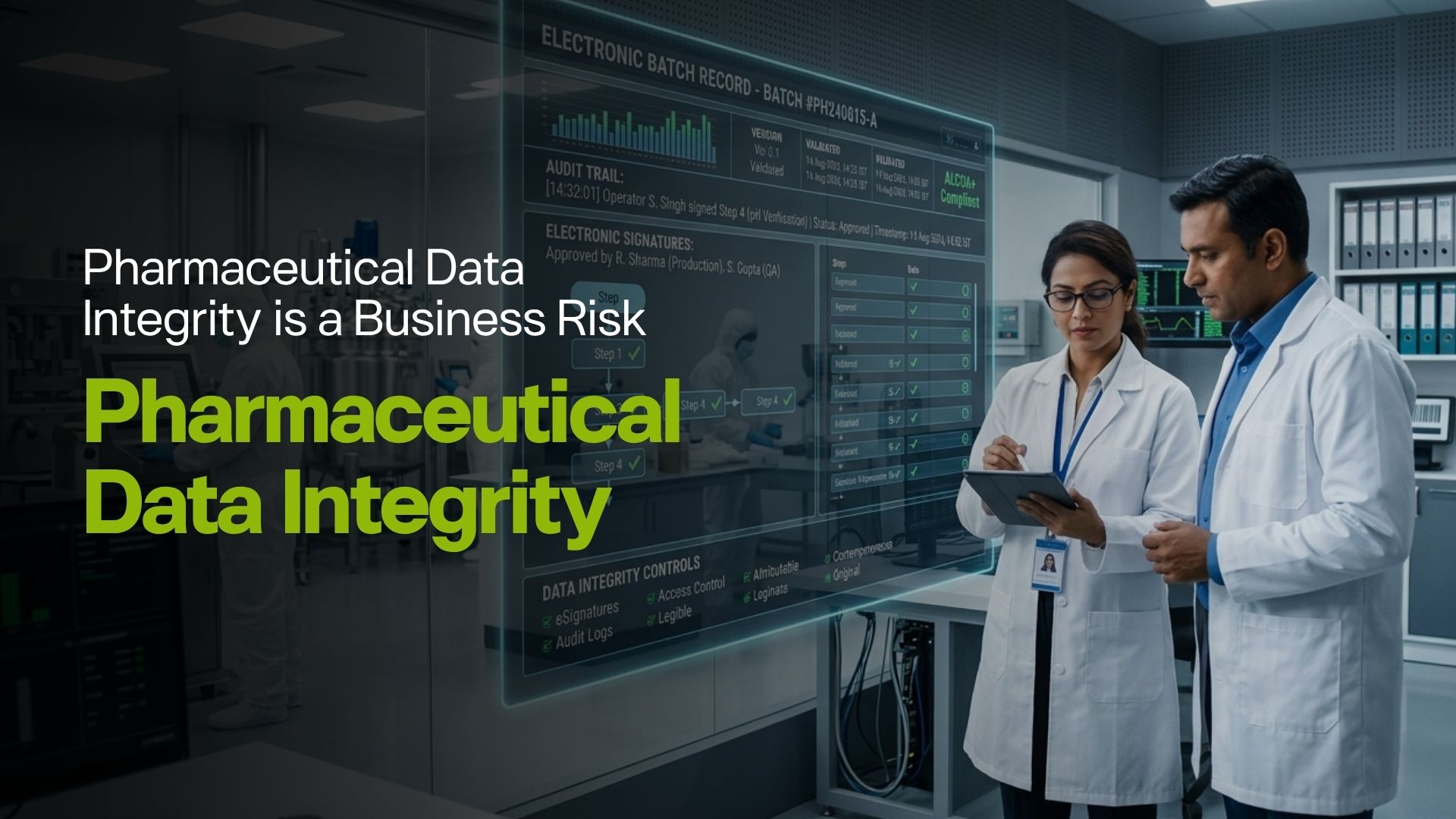
Pharmaceutical Data Integrity is a Business Risk
Pharmaceutical data integrity has become one of the most critical compliance and business risks in the pharmaceutical industry. Regulatory agencies like the USFDA increasingly issue Form 483 observations related to data integrity failures, particularly in manufacturing and laboratory records.
For years, pharmaceutical data integrity has been treated as a regulatory checklist item. A quality department concern. A CSV validation exercise.
But for CXOs and VPs in Indian pharma manufacturing, pharmaceutical data integrity is now becoming a hot boardroom issue.
What Is Pharmaceutical Data Integrity?
Why Data Integrity Is a Growing Risk for Pharma Companies?
- According to the USFDA’s published inspection observations, data integrity deficiencies have consistently remained among the top reasons for 483 observations issued to Indian pharmaceutical manufacturers over the last decade.
- Industry estimates suggest that remediation of a single major data integrity lapse can cost between $1–5 million, including investigations, re-validations, production delays, and reputational damage.
- In severe cases, warning letters and import alerts can freeze exports, impacting revenue pipelines overnight.
Pharmaceutical data integrity now doesn’t limit to “Are records complete?”
The expectation has shifted to “Can your data withstand global scrutiny in real time?”
Pharmaceutical Data Integrity and the Hidden Cost of ‘Delayed Decisions’
Many pharma plants in India still operate in a hybrid mode:
- Operators write data manually.
- Supervisors verify retrospectively.
- Delayed QA reviews.
- Investigations begin when deviations surface.
Many plants suffer from time discrepancies where:
- Material is already consumed.
- Production time is lost.
- Release timelines are delayed.
- Export commitments are stressed.
Pharmaceutical data integrity, when designed correctly, eliminates these risks.
It moves the system from:
Documentation to Review to Correction
to
Capture to Validate to Decide (in real time)
Pharmaceutical Data Integrity: From ALCOA++ to “Decision-Grade Data”
Yes, we know ALCOA++ (Attributable, Legible, Contemporaneous, Original, Accurate + Complete, Consistent, Enduring, Available + Traceable, Secure).
But here is the strategic question:
Is your data merely compliant?
Or is it decision-grade?
Pharmaceutical data integrity in 2026 must go beyond audit readiness.
It must enable:
- Real-time batch health visibility
- Predictive/Real Time deviation detection
- Automated cross-verification between IPQC, BMR, and LIMS
- Exception-driven QA review instead of 100% manual scrutiny
Leading global pharma organizations are investing heavily in integrated digital ecosystems (eBMR, LIMS, MES integration). McKinsey’s research on digital manufacturing maturity suggests that companies implementing advanced digital operations see productivity gains of 15–30% and quality improvements of up to 20%.
For Indian pharma exporters competing in US, EU, and regulated markets, this is no longer optional.
Pharmaceutical data integrity is not a defensive strategy. It is an offensive growth strategy.
Imagine this scenario:
- During a USFDA inspection, your system can retrieve any historical batch parameter in seconds.
- Audit trails are automated, tamper-evident, and traceable.
- IPQC results sync instantly with production dashboards.
- QA workload reduces because the system flags only exceptions.
What does this create?
Confidence.
Not just regulatory confidence. Commercial confidence.
Global customers increasingly audit manufacturing sites before partnerships. A digitally mature, data-integrity-strong plant signals: Reliability, Governance discipline, Risk mitigation and Scalability
In global pharma, trust converts to contracts.
Innovative Ideas for Strengthening Pharmaceutical Data Integrity in Indian Plants
To move beyond compliance, CXOs can consider:
1. Real-Time Integrity Dashboards for Leadership
A plant-level dashboard that flags:
- Late Running Tasks
- Data edits
- Overwritten records
- Repeated deviation patterns
Board-level visibility changes behavior instantly.
2. “Decision Velocity” Index
Measure how long it takes from:
- Data entry to QA visibility
- IPQC result to Production action
Shorter decision cycles = stronger pharmaceutical data integrity.
3. Exception-Based QA Model
Instead of reviewing every line item, leverage:
- Automated validation rules
- Statistical anomaly detection
- Cross-system reconciliation
Free QA bandwidth for high-risk investigations.
Pharmaceutical Data Integrity: The Leadership Question
For Indian pharma leaders, the real question is not:
“Are we compliant today?”
It is:
“If inspected tomorrow, can our data tell a flawless story without human explanation?”
In the coming decade, regulatory scrutiny will intensify. AI-driven review tools are already being explored globally for anomaly detection in submissions.
Plants that embed pharmaceutical data integrity into their operational DNA will move faster, respond quicker, and scale globally with confidence.
Those who treat it as documentation hygiene will remain reactive.
Pharmaceutical data integrity is no longer about protecting the past.
It can become your vehicle to accelerate into the future.