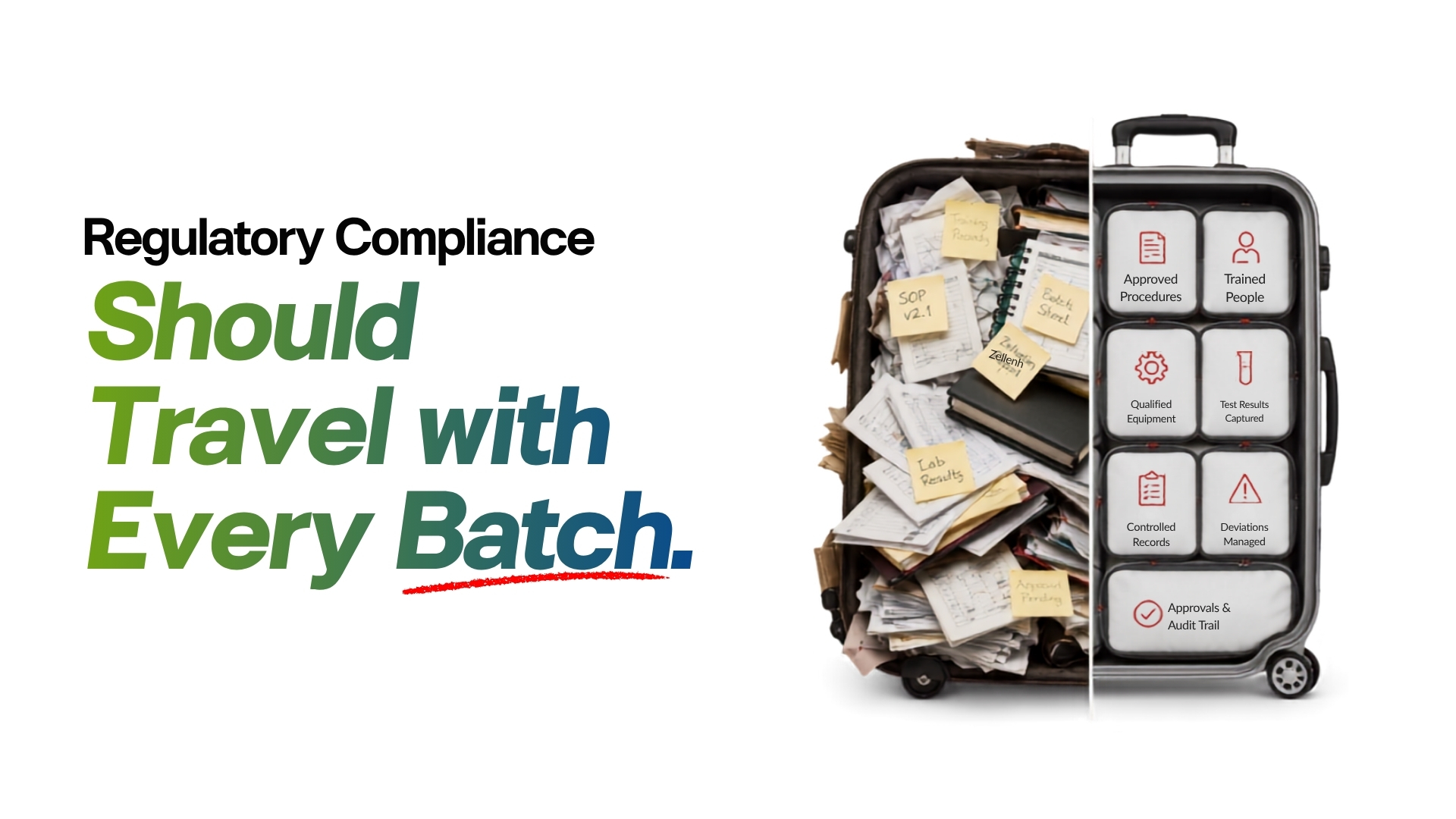
Pharmaceutical compliance is often discussed in terms of regulations, audits and documentation. On the plant floor, however, compliance is much more practical.
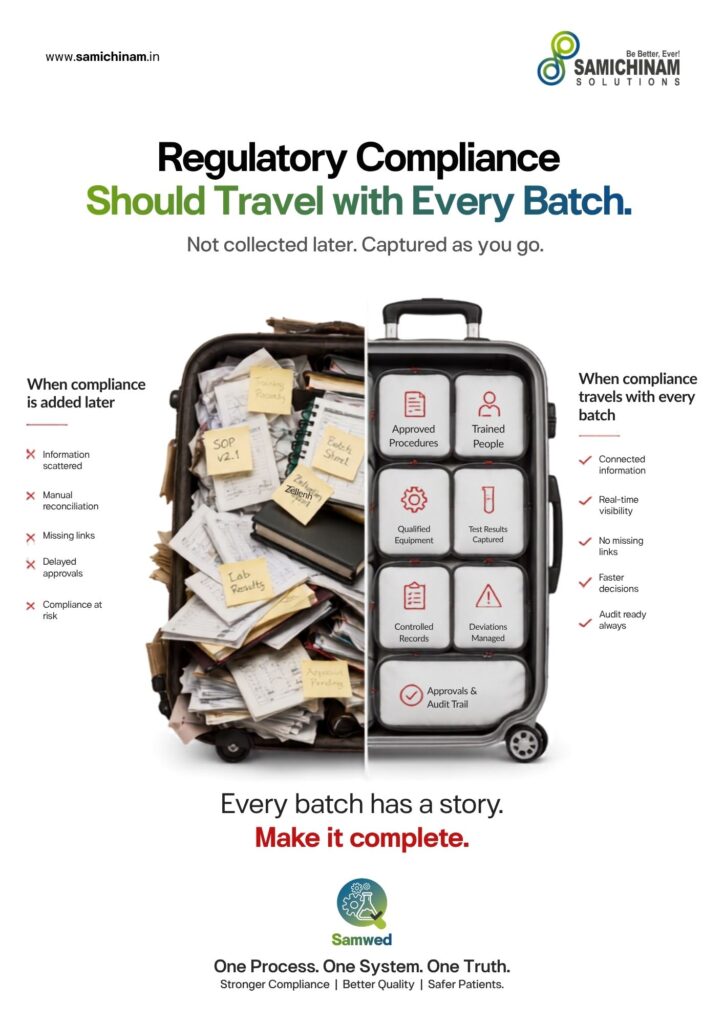
It is the ability to prove that the right material was used, the approved procedure was followed, the assigned person was qualified, the equipment was fit for use, the result was reviewed and every unexpected event was properly assessed.
This evidence should not need to be assembled. It should travel with the process from beginning to end.
Compliance Is a Chain of Connected Decisions
A batch moves through multiple functions before release. Materials are received and sampled. Equipment is prepared. Manufacturing instructions are executed. In-process and finished-product tests are completed. Deviations, if any, are investigated and records are reviewed.
Each stage creates information that supports subsequent decisions..
The departments may have well defined processes and executions to manage their individual responsibilities. However, when they are not interconnected, the cross department information generated during execution is not available instantly. This introduces delays, additional efforts of coordination, reconciliation and reviews.
This is a challenge as well as opportunity.
Regulatory compliance becomes stronger when every decision is supported by traceable information and has supporting evidence.
What Does Compliance by Design Mean?
Compliance by design means configuring regulatory and quality requirements directly into operational workflows.
Rather than completely depending on employees to remember every requirement and check, the process itself guides execution. It ensures that required information is entered, approvals follow the correct sequence and exceptions are routed to authorized personnel.
A compliance-by-design workflow can verify:
- Whether the latest version of procedure is being used
- Whether the employee is trained appropriately for the task
- Whether the equipment is usable and available
- Whether required information and checks are complete
- Whether information is approved by authorized person Whether any type of incident, deviation, OOS etc are routed through appropriate quality processes.
- Whether linked actions are completed before closure
The system in place does not replace professional human judgement or organizational responsibilities; but it provides a controlled, consistent environment in which people can execute their responsibilities without missing the tasks and the decisions are backed by informed judgements.
The Four Layers of Digital Compliance
1. Process control
Systematic approved workflows define who executes a specific task, , who reviews and approves each activity. Built-in checks of roles and data entry during execution reduce the likelihood of incomplete or unauthorized execution as well as multiple reviews as the system itself can apply some checks on entered data and can drive decisions
2. Data integrity
Electronic records, audit trails, timestamps and e-signatures help create and maintain original, attributable, contemporaneous and traceable information throughout the lifecycle of the process.
3. Connected evidence
Documents, training records, equipment history, laboratory results, manufacturing activities and quality events and evidence associated as and where required, remain linked to the process they support.
4. Risk visibility
Dashboards, trend reports and alerts help teams identify overdue activities, recurring deviations and developing process variance before they become larger issues. The structured and connected information available helps finding patterns easily and hence act on them efficiently. This enables a more proactive approach to quality oversight and risk management.
Why Standalone Digital Tools Are Not Enough
Digitizing individual departments can reduce paper, but it may also create digital silos.
A QMS may record a deviation while the relevant laboratory data sits in a separate LIMS. Training information may remain in another application, while equipment usage and batch execution are managed elsewhere.
The result is digital documentation without end-to-end digital clarity.
True transformation requires these functions to exchange information within a common process framework. A change to an SOP should trigger the appropriate training requirement. An equipment issue should become visible during investigation. A laboratory exception should connect with the affected batch and related quality workflow, production process should not use equipment which is uncalibrated.
Each individual system can perform its intended function effectively. However, when information and workflows are connected, organizations gain greater visibility across the complete process.
The objective is not simply to introduce more software or replace every existing application. It is to establish continuity between the processes, decisions and evidence that support pharmaceutical quality.
From Generative AI to Predictive Compliance
AI in pharmaceutical compliance is not limited to generative AI.
Generative AI can assist with activities such as drafting, summarizing and reviewing information, subject to appropriate controls and human verification.
Predictive AI can go further by analysing structured historical and operational data to identify recurring patterns, process variations and emerging risk indicators.
the value AI can bring on the table, depends on the quality and context of the underlying data. When records are incomplete or fragmented, AI has only a partial picture which may lead to inappropriate analysis and decision making. When processes and information are connected, AI can provide more meaningful decision support.
The quality team remains responsible for the final assessment, approval and action. AI should complement, not replace, the expertise and accountability of pharmaceutical professionals. Its outputs must be appropriately assessed before they influence regulated decisions.
How SAMWED Makes Compliance Part of Execution
SAMWED is designed around Quality by Design principles, integrating compliance requirements into everyday pharmaceutical workflows.
Its unified Pharma 4.0 suite covers Quality Management, Document Management, Training, Laboratory operations through LIMS++, LES++, ELN and Environmental Monitoring, Equipment Care and Smart Logbooks, Manufacturing through eBMR++ and eBPR++, Store Management and System Validation.
Configurable workflows adapt to specific objectives, products and site requirements. Electronic records, audit trails, structured risk assessments and real-time dashboards improve control and traceability across operations.
Organizations can begin with selected modules and expand progressively. Because every module is part of the same process engine, digital growth does not have to create another layer of disconnected systems. Moreover, being part of the same process engine, they also integrate with each other seamlessly. Explore the SAMWED Suite
Build Compliance into the Work
Regulatory compliance should not depend on retrieving and reconciling information after an activity is completed.
It should be created naturally as trained people execute approved processes using qualified systems.
The future of pharmaceutical compliance is not just more digital documentation. It is connected processes, contextual evidence and better-informed decisions. When compliance travels with every process, every batch carries a stronger, more traceable story of how it was executed and controlled.